[00:05] (5.04s)
I'm here today with James Hawkins, CEO
[00:06] (6.88s)
and founder of Post Hog from the YC
[00:08] (8.64s)
Winter20 batch. James is here hot off
[00:10] (10.72s)
the news of raising a 75 million series
[00:13] (13.28s)
Z round of funding at a $ 1.4 billion
[00:16] (16.08s)
valuation, making Postto the latest YC
[00:18] (18.64s)
unicorn. Today we're going to talk about
[00:20] (20.64s)
how Postto got started, how they pulled
[00:22] (22.80s)
off what I think is one of the best YC
[00:24] (24.88s)
pivots of the last decade, and how they
[00:26] (26.96s)
use attention and humor to compete with
[00:29] (29.52s)
not just other tech companies, but with
[00:31] (31.60s)
everything out there for attention.
[00:33] (33.84s)
Welcome, James. Thank you for having me.
[00:35] (35.84s)
James, could you tell us what is Post
[00:38] (38.00s)
Talk? Explain it to us a little bit.
[00:39] (39.68s)
>> Sure. So with YC, I always feel like
[00:41] (41.28s)
this is my homework being marked by the
[00:43] (43.28s)
teacher. Um, we help users to debug
[00:47] (47.68s)
their product to ship features faster
[00:50] (50.24s)
through kind of things like feature
[00:51] (51.44s)
flags and so on. And we help keep all
[00:52] (52.80s)
their kind of customer and product data
[00:53] (53.92s)
in one stack.
[00:55] (55.04s)
>> And tell us a little bit about um the
[00:57] (57.44s)
state of the company, how how big it is.
[00:59] (59.52s)
You guys are pretty big these days. G
[01:01] (61.20s)
give our give our viewers a snapshot of
[01:03] (63.60s)
what's going on at Post Talk.
[01:04] (64.72s)
>> Sure. Yeah. So, we're about 160 people.
[01:07] (67.12s)
Um, we're around 300,000 customers
[01:09] (69.60s)
across like free a lot of free customers
[01:11] (71.68s)
and paid. um we have several thousand
[01:13] (73.20s)
paid. We have I think 16 or 17 products
[01:16] (76.56s)
kind of in production or um in
[01:18] (78.80s)
development. They're all at different
[01:20] (80.24s)
kind of stages. And we've been I guess
[01:21] (81.76s)
like at the moment the main thing we're
[01:22] (82.88s)
doing and the reason kind of why we did
[01:23] (83.92s)
a lot of raising this year. Um we're
[01:27] (87.04s)
pushing very hard on getting more
[01:29] (89.12s)
products still out of the door. So
[01:30] (90.72s)
instead of kind of going up market,
[01:31] (91.84s)
we're going just across more of kind of
[01:33] (93.76s)
the customer data that people are
[01:35] (95.28s)
generating. Um, and we're automating a
[01:37] (97.44s)
ton of things through AI, which has been
[01:39] (99.20s)
a long and arduous pro process. Um, but
[01:42] (102.24s)
we're starting to get to the point where
[01:43] (103.12s)
I'm starting to get proud of what we've
[01:44] (104.72s)
achieved so far, but I still kind of
[01:46] (106.72s)
feel like ah, we haven't got started
[01:48] (108.24s)
yet. There's a lot more to go. Um, which
[01:50] (110.56s)
I don't think is a feeling it will ever
[01:51] (111.68s)
go probably, but um, yeah, it's like
[01:53] (113.68s)
proving a lot of fun and we're just
[01:54] (114.88s)
starting to scale up pretty aggressively
[01:56] (116.64s)
now. Like we're I think we start at 70
[01:58] (118.64s)
people this year. Um, and so we're
[02:01] (121.60s)
supposed to be about 200ish by the end
[02:02] (122.72s)
of the year or something. So it's time
[02:03] (123.84s)
to get properly and to kind of scale up
[02:05] (125.04s)
maybe at this point.
[02:05] (125.84s)
>> So you've got this team, you've got all
[02:07] (127.76s)
these customers, you have all these
[02:09] (129.20s)
products that you're developing and
[02:10] (130.40s)
improving on, but what what was the
[02:12] (132.32s)
initial product that Post HTog started
[02:13] (133.92s)
with? What was that the first thing that
[02:15] (135.36s)
you guys brought to market as Post Hog?
[02:17] (137.04s)
>> Sure. So yeah, the first thing that
[02:18] (138.16s)
worked for us, we had a bunch of pivots
[02:19] (139.36s)
before um was self-hosted product
[02:22] (142.32s)
analytics because we pivoted so many
[02:24] (144.16s)
times and every time we had to set up
[02:25] (145.52s)
product analytics over and over again
[02:26] (146.80s)
and we're just getting frustrated having
[02:28] (148.32s)
to implement it. I think we found that
[02:30] (150.00s)
there's an awful lot of really strong
[02:32] (152.40s)
competition. Um, but we felt all the
[02:34] (154.32s)
products were built for kind of product
[02:35] (155.92s)
managers to force engineers to go
[02:37] (157.36s)
implement. But as like reasonably
[02:38] (158.72s)
technical, especially my co-founders, a
[02:40] (160.08s)
very technical co-founder was just
[02:41] (161.68s)
getting annoyed at like I can't I want
[02:43] (163.20s)
to write SQL. I want to see the data
[02:44] (164.80s)
underneath. I would like to keep this in
[02:46] (166.40s)
my infrastructure so I don't lose data
[02:47] (167.68s)
due to ad blockers. So we thought, okay,
[02:49] (169.12s)
we think there's room for a self-hosted
[02:51] (171.36s)
alternative. And we also we spent some
[02:53] (173.28s)
time talking to potential customers. Um,
[02:56] (176.64s)
and we found that quite a lot of people
[02:58] (178.00s)
had self-built their analytics stack and
[02:59] (179.92s)
we're maintaining this kind of junky
[03:01] (181.92s)
system which we felt if we can
[03:04] (184.00s)
productize something like that because
[03:05] (185.12s)
new infrastructure and we could see this
[03:06] (186.72s)
working quite well. Um, so yeah, we
[03:08] (188.80s)
started with just open source product
[03:09] (189.84s)
analytics on hacker news. We spent like
[03:11] (191.52s)
the last four weeks of the batch uh
[03:14] (194.16s)
desperately trying to get that out of
[03:15] (195.52s)
the door and then we hit like we
[03:17] (197.36s)
actually we didn't really pivot we
[03:18] (198.96s)
iterated I would say afterwards and now
[03:20] (200.32s)
we're all cloud-based with multi-roduct
[03:21] (201.92s)
but that was the thing that landed um
[03:24] (204.16s)
for us finally I think of postg um well
[03:26] (206.56s)
there's this meme um among founders of
[03:28] (208.64s)
pivot hell and it's a thing that YC
[03:30] (210.56s)
founders talk about a lot where you're
[03:32] (212.08s)
going from idea to idea to idea and
[03:34] (214.40s)
you're trying to find something that's
[03:35] (215.68s)
going to work and you guys not only came
[03:37] (217.76s)
out of pivot hell and have built this
[03:40] (220.00s)
awesome
[03:41] (221.04s)
But what you built was literally forged
[03:43] (223.04s)
in the fires of pivot hell,
[03:45] (225.20s)
>> right? Like while doing these pivots,
[03:47] (227.36s)
you had this pain that only came because
[03:49] (229.36s)
you were doing the pivots and trying to
[03:50] (230.72s)
do them at a high level, setting up the
[03:52] (232.48s)
analytics over and over again. Tell us a
[03:54] (234.56s)
little bit about how you guys actually
[03:56] (236.32s)
got to YC and and started this journey
[03:59] (239.52s)
of of pivoting and finding startup ideas
[04:02] (242.16s)
that might work. my co-founder uh quit.
[04:05] (245.04s)
We used to work together. Um and when I
[04:06] (246.80s)
heard news that he was leaving, um I had
[04:10] (250.24s)
also been thinking about leaving and
[04:11] (251.84s)
that kind of triggered me to go, okay, I
[04:12] (252.88s)
want to do my own thing. Um so I made
[04:14] (254.64s)
sure to grab him and instead of getting
[04:15] (255.92s)
him to go off and work in um another
[04:17] (257.92s)
startup, whatever, I thought, hey, let's
[04:18] (258.96s)
just do our own thing.
[04:19] (259.68s)
>> And when he when he was leaving, was he
[04:21] (261.28s)
leaving to join another company? Was he
[04:22] (262.96s)
leaving to start something?
[04:23] (263.76s)
>> Yeah, I think he was actually trying to
[04:24] (264.48s)
get a job at Facebook at the time. He
[04:26] (266.96s)
was doing an incremental kind of career
[04:28] (268.32s)
move. Um and I think I showed up being
[04:29] (269.76s)
like I think I have this idea that we'll
[04:31] (271.04s)
probably have product market fit for in
[04:32] (272.24s)
a couple of weeks time.
[04:33] (273.76s)
>> Of course. Of course they are.
[04:34] (274.96s)
>> Of course. Yeah. It's only a hop skip
[04:36] (276.24s)
and a jump away and then we can just you
[04:37] (277.76s)
know um I had like a I'd created a list
[04:40] (280.00s)
of problems I'd encountered
[04:41] (281.76s)
professionally thinking okay I should
[04:42] (282.96s)
solve a problem I've had myself and we
[04:44] (284.40s)
started going through the list but we
[04:45] (285.84s)
thought we wanted to bootstrap
[04:46] (286.96s)
initially. So the two of us were just
[04:48] (288.64s)
like working out of coffee shops. One of
[04:51] (291.12s)
the main problems we found was every
[04:52] (292.32s)
time we went to see a customer, we'd
[04:53] (293.84s)
have to buy another round of coffee. And
[04:55] (295.12s)
so we'd often end up getting like
[04:57] (297.04s)
whatever the coffee equivalent of wasted
[04:58] (298.64s)
is basically. Um so eventually we we did
[05:02] (302.16s)
this for about 6 months and we worked
[05:03] (303.68s)
through an average of one idea every
[05:06] (306.08s)
like five probably average about five or
[05:07] (307.68s)
six weeks.
[05:08] (308.08s)
>> Do you remember what any of those ideas
[05:09] (309.68s)
>> Yeah. Um so the initial thing we tried
[05:11] (311.60s)
to build was a sales territory
[05:13] (313.12s)
management product. So, I used to run a
[05:15] (315.04s)
sales I was VP of sales and I felt that
[05:17] (317.44s)
like in sales, you're literally wasting
[05:19] (319.68s)
over 90% of your time because deals
[05:22] (322.16s)
don't usually win. They don't usually
[05:24] (324.24s)
close. Like they usually just float
[05:25] (325.36s)
around and gradually get killed off. And
[05:27] (327.76s)
we thought if we get better at not
[05:29] (329.04s)
focusing on deals that are closing, but
[05:30] (330.40s)
on the ones that aren't closing, getting
[05:31] (331.68s)
a bit more ruthless at using statistics
[05:33] (333.20s)
to pull them out of people's pipeline
[05:34] (334.88s)
and change the territory for the sales
[05:36] (336.08s)
team is what I thought might work. Um,
[05:37] (337.84s)
and it was just kind of really
[05:38] (338.72s)
complicated um to build and I think
[05:41] (341.20s)
because I'm much more technical than a
[05:43] (343.20s)
traditional sales leader would be, I
[05:44] (344.80s)
just think we built something kind of
[05:46] (346.00s)
complicated and I don't think our go to
[05:48] (348.08s)
market was right or anything. Um, yeah,
[05:49] (349.84s)
we had this idea, we built it. I think
[05:52] (352.00s)
the thing that was important or the
[05:53] (353.52s)
harsh lesson I learned was my co-founder
[05:55] (355.52s)
was building it. I was just trying to
[05:56] (356.64s)
get interesting prospects to buy it from
[06:00] (360.16s)
us. Um, so I had about I got through I
[06:02] (362.32s)
got about 15 sort of series B, C, D um,
[06:05] (365.60s)
sales leaders queued up saying they
[06:07] (367.60s)
wanted to use this. Well, they said they
[06:09] (369.52s)
wanted to use it. We got the first
[06:11] (371.36s)
version done in a couple of weeks. Send
[06:12] (372.88s)
them the link to create an account. Of
[06:14] (374.64s)
the 15 um 14 of them didn't even click
[06:17] (377.52s)
the link. One click the link and then
[06:18] (378.88s)
didn't create an account. And we're like
[06:20] (380.88s)
um it was like first good we should have
[06:22] (382.32s)
read the mom test was the we hadn't done
[06:24] (384.08s)
any of the user interviews correctly.
[06:25] (385.60s)
Um, but I also it made me feel that
[06:27] (387.76s)
building for sales people or sales
[06:29] (389.76s)
leaders in particular, I feel the signal
[06:31] (391.76s)
to noise ratio is pretty poor. Um,
[06:34] (394.00s)
because they're really quite willing to
[06:36] (396.00s)
hop on quick calls and are very very
[06:37] (397.52s)
positive and kind of very friendly
[06:38] (398.96s)
people. A little bit later it kind of
[06:40] (400.64s)
dawned on us that we think we'd be
[06:43] (403.04s)
better because we're not very good at
[06:44] (404.24s)
product. We're terrible at product
[06:45] (405.52s)
initially because we're kind of bad. We
[06:47] (407.36s)
need to deal with people that are what
[06:49] (409.44s)
they say is close to what they'll do.
[06:50] (410.96s)
And we felt that like natural problem
[06:52] (412.80s)
solver people like engineers or customer
[06:54] (414.56s)
support people probably would be a
[06:56] (416.08s)
better audience for us to work with
[06:57] (417.36s)
because out of all the many variables
[06:58] (418.96s)
you can get wrong. Like it might be like
[07:00] (420.32s)
your product's incredible but you're
[07:01] (421.36s)
terrible at explaining what it does.
[07:02] (422.88s)
You'll still fail. Um and we thought
[07:04] (424.64s)
that okay one of the variables we can
[07:06] (426.24s)
remove from this equation is the person
[07:09] (429.60s)
being a little bit um easier to read
[07:11] (431.84s)
basically. And so that was a big part of
[07:13] (433.68s)
why we wanted to build something dev
[07:15] (435.44s)
tooly later on was that sort of
[07:17] (437.04s)
realization.
[07:18] (438.00s)
>> Um but yeah that was the first thing
[07:19] (439.52s)
that we worked on. And so when you guys
[07:20] (440.88s)
did Y Combinator, the product that you
[07:22] (442.72s)
had was another pivot was having
[07:24] (444.88s)
developers take surveys about technical
[07:27] (447.52s)
debt when they would submit a poll
[07:29] (449.28s)
request.
[07:29] (449.84s)
>> And so you'd already done a few products
[07:31] (451.36s)
by that point.
[07:32] (452.32s)
>> You came into YC with another one. Did
[07:35] (455.20s)
you guys have a like how did you kind of
[07:37] (457.12s)
keep your spirits up or how did you
[07:39] (459.28s)
track your trajectory? Did you feel you
[07:41] (461.28s)
were getting stronger or better or
[07:43] (463.36s)
closer to the target as you were going
[07:44] (464.96s)
through these pivots? I would like to
[07:47] (467.12s)
think that was true. I'm not sure it
[07:48] (468.16s)
was. We didn't reflect on that. We
[07:49] (469.04s)
should have asked like are we actually
[07:49] (469.92s)
getting better each time around? Um I
[07:52] (472.32s)
think we should have run a retrospective
[07:53] (473.52s)
basically. I don't think we actually
[07:54] (474.96s)
were getting that much better each time.
[07:56] (476.24s)
There are definitely some things that
[07:56] (476.96s)
were consistently very important to us
[07:58] (478.48s)
though. Like for example, we went full
[08:00] (480.24s)
gas on each idea. Like we didn't sort of
[08:02] (482.00s)
like call it in. Like we would go in
[08:04] (484.32s)
person to every single customer that was
[08:06] (486.64s)
remotely interested, we would go in
[08:07] (487.44s)
person to go meet. Like we started in uh
[08:09] (489.36s)
England and came to San Francisco to do
[08:11] (491.20s)
YC. like we'd catch like a bunch of
[08:12] (492.88s)
trains and buses to get to a customer in
[08:14] (494.56s)
some random place and like we would put
[08:16] (496.16s)
the effort in to go really push it
[08:18] (498.24s)
because then kind of what happens when
[08:19] (499.28s)
we started charging for a lot of these
[08:20] (500.64s)
products. You would find that oh I'm not
[08:23] (503.44s)
failing this cuz I don't have a
[08:24] (504.40s)
relationship or like I'm kind of
[08:25] (505.92s)
friendly with this customer at this
[08:27] (507.28s)
point and they still don't want to buy
[08:28] (508.48s)
from us. This is a really good sign this
[08:30] (510.08s)
product isn't solving the problem. This
[08:32] (512.08s)
really demonstrates to me it's a nice to
[08:33] (513.36s)
have. Like in my previous job, um, we
[08:35] (515.76s)
used to sell comp like enterprise
[08:37] (517.12s)
software for millions of dollars a year.
[08:38] (518.96s)
And I can remember multiple times
[08:40] (520.40s)
thinking I'm having to work kind of as
[08:42] (522.32s)
hard to sell a like $50 a month SAS
[08:44] (524.88s)
subscription as I was to sell like a
[08:46] (526.40s)
$100,000 a year plus deal in my last
[08:49] (529.12s)
>> I know that I've tried really hard. Um,
[08:51] (531.28s)
and so I can rule out one of the other
[08:52] (532.72s)
variables I guess is like, are you
[08:53] (533.92s)
actually trying as hard as you could be?
[08:55] (535.52s)
And we were. I think that helped us feel
[08:57] (537.12s)
confident enough to go this just isn't
[08:58] (538.88s)
working. So yeah, we just we worked very
[09:00] (540.64s)
hard. And it look I I remember it
[09:02] (542.08s)
feeling weird like on LinkedIn for
[09:03] (543.28s)
example I talk about like hey this is
[09:05] (545.12s)
what we're up to and it would be like
[09:06] (546.40s)
one week it was like some dev tool next
[09:08] (548.88s)
week it's a CRM thing. Um but we just
[09:11] (551.28s)
didn't care like we just threw ourselves
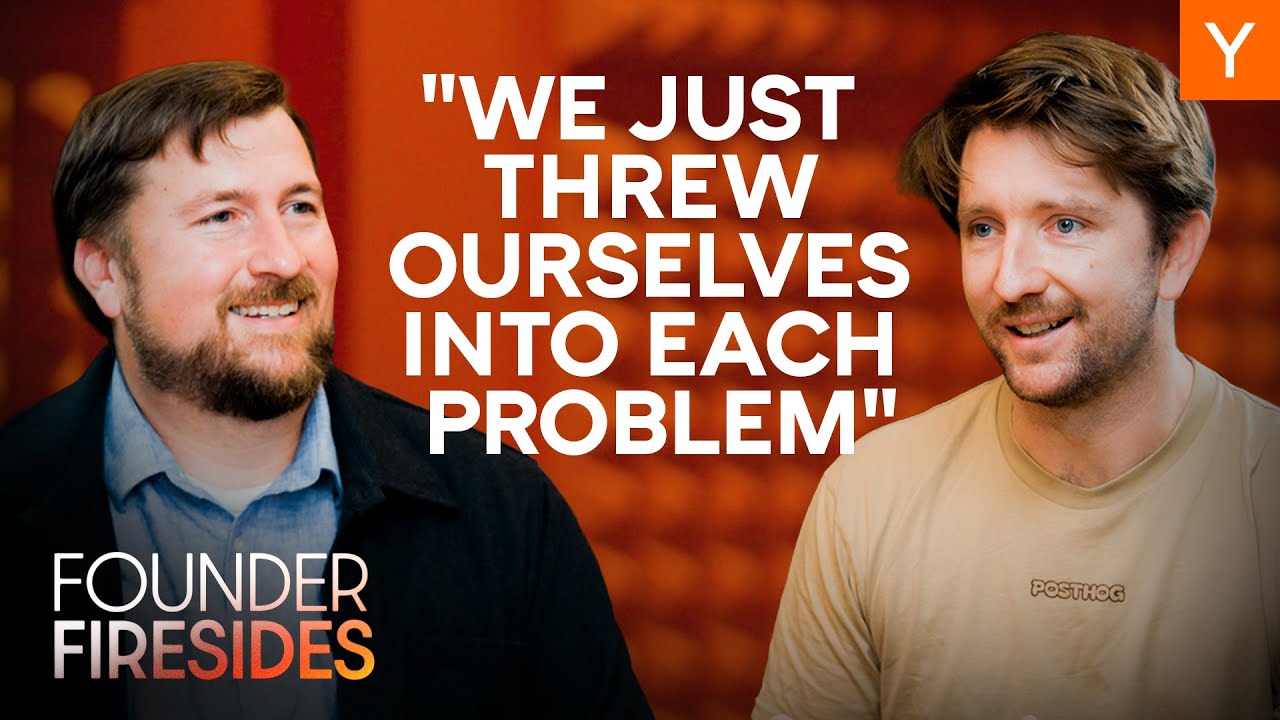
[09:12] (552.48s)
into each problem.
[09:14] (554.00s)
>> There's an aspect of shamelessness that
[09:15] (555.60s)
you have to have to just kind of keep up
[09:17] (557.52s)
the momentum and keep trying and not get
[09:19] (559.20s)
bogged down. I think it's easy for it to
[09:20] (560.72s)
feel kind of lame almost. Like yeah, you
[09:22] (562.16s)
have friends who are like in investment
[09:24] (564.00s)
banking or they have these like proper
[09:25] (565.36s)
careers and we're doing something that
[09:26] (566.32s)
just seems so kooky, but like that's the
[09:28] (568.56s)
bit I think that is a specific reason
[09:30] (570.32s)
why most people don't run companies
[09:32] (572.72s)
because that first bit is like all is so
[09:34] (574.40s)
existential and all over the place. I
[09:36] (576.24s)
think we just have faith that if we just
[09:37] (577.44s)
keep making the input we're looking at
[09:38] (578.72s)
is like are we making very regular real
[09:40] (580.64s)
progress? So on the ideas we'd often at
[09:42] (582.40s)
the start of the week be like okay by
[09:44] (584.00s)
the end of this week what is the list of
[09:45] (585.36s)
things we will feel good if we get them
[09:46] (586.96s)
all done and it would be something like
[09:48] (588.56s)
okay we want to do like 10 custom
[09:49] (589.92s)
meetings build these three big features
[09:52] (592.00s)
um and we just held ourselves to account
[09:54] (594.00s)
on a like very short cadence all the
[09:56] (596.16s)
time as people I think we got much
[09:58] (598.32s)
stronger at things like product much
[09:59] (599.84s)
later on once post dog had sort of taken
[10:02] (602.24s)
off but I think we were just like very
[10:03] (603.68s)
we just yeah put our heart into things
[10:05] (605.52s)
we're very fast that was kind of all we
[10:07] (607.04s)
needed I think realistically you guys
[10:08] (608.56s)
were working through these pivots maybe
[10:10] (610.48s)
getting better, maybe not. Trying to be
[10:12] (612.32s)
wholehearted, trying to be consistent,
[10:13] (613.76s)
trying to be really committed to the
[10:14] (614.96s)
bit, maybe as a comedian would say, when
[10:17] (617.36s)
you started with the open source product
[10:19] (619.12s)
analytics, what became the final pivot,
[10:21] (621.04s)
what signals did you get early on or
[10:23] (623.04s)
signs that maybe this is it, maybe we're
[10:25] (625.60s)
really on to something was a month
[10:27] (627.28s)
before YC demo day. Tell us a little bit
[10:29] (629.52s)
about how that unfolded.
[10:31] (631.20s)
>> Yeah, so I think um we had a slightly
[10:32] (632.72s)
higher level of excitement about this
[10:34] (634.56s)
idea ourselves. I think we had had a
[10:37] (637.04s)
couple of ideas where in our heart of
[10:38] (638.72s)
hearts we weren't that interested in
[10:40] (640.32s)
them. Like we were kind of doing them
[10:41] (641.36s)
because we like felt like we had to get
[10:42] (642.80s)
something to work. Um whereas I think
[10:44] (644.56s)
this one and we had an office hours here
[10:46] (646.80s)
and I can remember and we're like well
[10:48] (648.48s)
we're kind of thinking about building
[10:49] (649.28s)
this thing that will do two at the time.
[10:51] (651.20s)
We thought there are two things are
[10:52] (652.08s)
important. We thought we want to capture
[10:53] (653.76s)
all user data completely automatically.
[10:55] (655.84s)
Like we don't want anyone to have to set
[10:56] (656.80s)
up event tracking manually. We didn't
[10:58] (658.40s)
realize someone had already built this.
[11:00] (660.16s)
Um and that didn't turn out to be
[11:01] (661.68s)
particularly important. But then the
[11:02] (662.96s)
second thing we're like we want to be
[11:03] (663.92s)
able to self-host this thing so that it
[11:05] (665.28s)
can say your infra and we came out the
[11:06] (666.80s)
office hours I was going ah that's not
[11:08] (668.24s)
the right framing it's open source
[11:09] (669.84s)
product analytics then it's not just
[11:11] (671.44s)
about it being your infrastructure it's
[11:13] (673.12s)
also just like a whole vibe like I think
[11:14] (674.72s)
immediately we were like we feel very
[11:16] (676.16s)
confident I could see that really
[11:17] (677.52s)
landing on hacker news that we both my
[11:19] (679.60s)
both read it and it just felt like the
[11:21] (681.52s)
kind of thing you would see on the front
[11:22] (682.64s)
page so the level of excitement was a
[11:24] (684.56s)
little bit higher for us I do think it's
[11:26] (686.08s)
a bad idea though to like sometimes I
[11:27] (687.76s)
see other founders they're like I'm
[11:28] (688.96s)
waiting for an idea that I'm excited
[11:30] (690.48s)
about but I think The reality is for us
[11:32] (692.88s)
it's we had to just build a bunch of
[11:34] (694.56s)
things to find the thing we're excited
[11:35] (695.76s)
about. What we didn't do was like sit
[11:37] (697.44s)
cross-legged on the top of a mountain
[11:39] (699.04s)
waiting for inspiration.
[11:40] (700.88s)
>> Um so by trying a few things we started
[11:42] (702.80s)
going this idea just doesn't feel good.
[11:44] (704.56s)
But we know that because we have tried
[11:46] (706.16s)
>> You had to find something in the middle
[11:47] (707.36s)
of what people want and what you're
[11:48] (708.96s)
excited about.
[11:49] (709.60s)
>> Yeah. Exactly. Um and so will I think
[11:51] (711.44s)
doing stuff gives you much stronger I
[11:52] (712.72s)
think it's like a Brian Armstrong quote
[11:53] (713.92s)
but like doing stuff gives you much
[11:54] (714.88s)
stronger signal more information. And
[11:56] (716.64s)
then I think when we started booking
[11:58] (718.32s)
interviews, it was a little bit easier
[12:00] (720.56s)
to get people to talk to us. Um, but the
[12:02] (722.32s)
big deal was on Hacker News when it was
[12:04] (724.40s)
just on the front page and had like it
[12:05] (725.84s)
wasn't the best ever. Like at the time
[12:07] (727.44s)
it was pretty good compared to what
[12:08] (728.48s)
happened before.
[12:08] (728.88s)
>> It was a good launch. We had a good
[12:09] (729.76s)
hacker news launch.
[12:10] (730.40s)
>> But if you look at it at like sort of
[12:11] (731.44s)
like 20 23 24 vintage hacking news
[12:14] (734.16s)
launches, it was very mediocre, but it
[12:15] (735.92s)
was enough to get an initial audience. I
[12:18] (738.56s)
I think um I because I go back to
[12:20] (740.16s)
people's old demo day slides a lot of
[12:21] (741.52s)
the times when helping batch founders
[12:23] (743.12s)
figure out what they should say. So I I
[12:24] (744.96s)
pull up the post hog slide every now and
[12:26] (746.56s)
then and I believe according to the
[12:28] (748.00s)
slide and I think it's true it was the
[12:29] (749.76s)
most uh upvoted dev tool hacker news
[12:33] (753.04s)
post of the year. So pretty good. I
[12:35] (755.12s)
remember being in the office hour you
[12:36] (756.72s)
probably shared the idea with a bunch of
[12:37] (757.92s)
people but I remember the first time I
[12:39] (759.04s)
heard it and it just made a lot of
[12:40] (760.88s)
sense. Uh there were a bunch of product
[12:42] (762.64s)
analytics uh companies out there but no
[12:45] (765.44s)
one had really gone all the way to make
[12:47] (767.36s)
this truly developer focused by going
[12:49] (769.60s)
open source. Um and so it just sounded
[12:51] (771.68s)
like something someone should try. Uh,
[12:53] (773.60s)
and uh, I wasn't that surprised that it
[12:55] (775.68s)
hit when it the way it did and was
[12:57] (777.52s)
really excited for you guys at the time.
[12:58] (778.96s)
So, okay. So, you had this um, you were
[13:01] (781.04s)
starting to get some users. You had to
[13:02] (782.88s)
go out and raise money for this thing at
[13:04] (784.24s)
demo day and you'd only been working on
[13:05] (785.44s)
it for a few weeks at that point. What
[13:07] (787.12s)
was that like? Like, how do you get your
[13:08] (788.48s)
conviction up to go, you know, pitch
[13:10] (790.40s)
investors about a product that's really
[13:12] (792.08s)
only a month old at this point? It was a
[13:13] (793.76s)
very mixed. Um, we at first we felt
[13:17] (797.04s)
really good. We're like, okay, it feels
[13:18] (798.00s)
like we can have this done in like two
[13:18] (798.96s)
days or three days. Slam dunk.
[13:20] (800.72s)
>> Yeah. Yeah, I think we're coming in
[13:21] (801.44s)
going like, "Yeah, we've had a really
[13:22] (802.32s)
solid launch." I think we were still
[13:23] (803.68s)
buzzing a little bit after like oh it's
[13:25] (805.12s)
such a a feeling of kind of relief that
[13:27] (807.04s)
suddenly we've got something where it
[13:28] (808.72s)
just instantly the day we launched it
[13:30] (810.00s)
went from being a push basis to a pull
[13:32] (812.24s)
basis getting people interested like
[13:33] (813.60s)
suddenly it's just like we're trying to
[13:34] (814.48s)
service all these random problems or
[13:36] (816.16s)
feature requests and stuff we can see
[13:37] (817.52s)
coming in and so we went out to raise I
[13:39] (819.68s)
think very confident like we thought
[13:40] (820.96s)
we'd kind of be pushing quite big
[13:42] (822.88s)
valuation at the time and I think we
[13:45] (825.68s)
felt that we will have this done in just
[13:47] (827.36s)
a few days um but our the timing was
[13:49] (829.60s)
horrible because it was 2020 in March
[13:51] (831.76s)
And the same week basically co went from
[13:54] (834.72s)
being this somewhat niche thing to
[13:56] (836.88s)
changing the world and everyone just
[13:58] (838.72s)
suddenly pulled out. So we kind of went
[14:00] (840.00s)
from feeling like oh we've got like all
[14:01] (841.28s)
the fanciest VC firms in the world are
[14:03] (843.36s)
interested in this thing to everyone's
[14:05] (845.36s)
pulled out and we're now doing like
[14:07] (847.68s)
we're trying to get angel checks for
[14:09] (849.52s)
5,000 bucks a pop to try and get all the
[14:11] (851.60s)
way up to like raising a few million
[14:12] (852.88s)
dollars. This is going to take a long
[14:14] (854.00s)
time. Um so it was very peaky and we
[14:17] (857.52s)
also had a lot of stress over like we're
[14:18] (858.96s)
in the US still. My wife was at home and
[14:21] (861.28s)
pregnant and I was worried about getting
[14:23] (863.12s)
stuck in America and my co-founder left
[14:26] (866.24s)
and because he was also worried about
[14:27] (867.36s)
getting stranded, overstaying his visa
[14:28] (868.64s)
and stuff. So there was just all this
[14:29] (869.84s)
chaos kind of happening. We just kept
[14:31] (871.76s)
plugging away basically. Um I think it
[14:33] (873.92s)
was very easy to it would have been very
[14:35] (875.28s)
easy I think to get disheartened and it
[14:37] (877.44s)
was painful but we just didn't I guess
[14:39] (879.04s)
we just kept going um was the main
[14:40] (880.72s)
thing. And so we were doing angel checks
[14:42] (882.96s)
um happily taking 5K off of people um
[14:46] (886.56s)
until eventually we got um a proper term
[14:50] (890.00s)
sheet um and that led to another one and
[14:51] (891.60s)
then we um got the round done very
[14:53] (893.44s)
quickly and then the market completely
[14:54] (894.64s)
picked up like even just a few months
[14:56] (896.40s)
later end up doing like a series A like
[14:58] (898.32s)
a month after the seed round had closed
[15:00] (900.16s)
but I think the statistics are something
[15:02] (902.40s)
>> I think we met 160 different firms in
[15:05] (905.44s)
the seed round. I think for like if I
[15:08] (908.08s)
added up the total number of pe number
[15:09] (909.68s)
of firms I've met for the series A, B,
[15:11] (911.36s)
C, D, and E,
[15:13] (913.68s)
probably like 20 uh in total like 30 in
[15:16] (916.16s)
total. It's it was by far the hardest
[15:18] (918.80s)
round we had to raise. Uh but also we
[15:20] (920.80s)
sucked it. It's not just them market
[15:22] (922.56s)
like we sucked at pitching. We're trying
[15:24] (924.32s)
to people please I think too much. Um so
[15:26] (926.00s)
we would be like well they were like
[15:27] (927.28s)
what are you going to do with the money
[15:28] (928.00s)
and it's like well you know we'll like
[15:29] (929.04s)
kind of get some revenue. We'll build
[15:30] (930.16s)
some features which is very vanilla
[15:32] (932.48s)
feeling. Um, and we had a lot of people
[15:34] (934.00s)
rejecting us because they felt we were
[15:35] (935.60s)
too early. But the reality was it's
[15:37] (937.44s)
like, well, we're dealing with a lot of
[15:38] (938.56s)
these investors have never invested at
[15:39] (939.76s)
that time. They never invested in open
[15:40] (940.80s)
source at all. Like the vast majority
[15:42] (942.56s)
hadn't. Um, because it was quite it was
[15:44] (944.08s)
much more unusual then. And I started
[15:46] (946.48s)
realizing that I don't even believe that
[15:48] (948.56s)
we'd want to spend money across all
[15:49] (949.60s)
these areas. Like we actually just want
[15:50] (950.64s)
to go full all in on the open source
[15:52] (952.08s)
project for a while. Um, again, I think
[15:54] (954.40s)
that's very bad advice for something
[15:55] (955.84s)
that doesn't have competition that's
[15:57] (957.36s)
making lots of revenue. So be very
[15:58] (958.56s)
careful with something like that. But we
[15:59] (959.92s)
started getting much more opinionated
[16:01] (961.04s)
and that's what started that eventually
[16:02] (962.16s)
landing. Hey, like you're out of your
[16:03] (963.76s)
mind if you think we're going to go big
[16:04] (964.88s)
on like hiring a big sales team or
[16:06] (966.64s)
trying to go into the enterprise or
[16:07] (967.68s)
something like it's just about building
[16:09] (969.52s)
this like nice big inbound kind of
[16:10] (970.96s)
community. We think is the if we can't
[16:12] (972.56s)
do that nothing else will follow and we
[16:14] (974.00s)
need to make really establish that
[16:15] (975.20s)
properly. Um so yeah, we got much punch
[16:17] (977.28s)
>> It's funny how that is. It's almost like
[16:18] (978.96s)
investors are pretty agnostic on what
[16:21] (981.60s)
the plan is. So long as there's a plan
[16:23] (983.92s)
>> and that you you're really passionate
[16:25] (985.44s)
about it and you've thought about it and
[16:26] (986.96s)
you're ready to go execute on it.
[16:28] (988.24s)
>> I think there's a Mark Benoff quote
[16:29] (989.36s)
which is something like um it's better
[16:30] (990.72s)
to be different than right. I think that
[16:32] (992.72s)
it's almost the equivalent here where I
[16:34] (994.08s)
think it's if you're trying to raise
[16:35] (995.60s)
money, it's better to have a plan that
[16:37] (997.60s)
than it is to necessarily be like
[16:39] (999.52s)
somewhat correct, like be either very
[16:41] (1001.52s)
clearly right or wrong because you'll
[16:42] (1002.64s)
learn something from that. So, that
[16:44] (1004.40s)
round was really hard. You talked to 160
[16:47] (1007.28s)
investors. It took months to get the
[16:49] (1009.52s)
money. Yeah. Okay.
[16:50] (1010.80s)
>> Fast forward to this this latest round
[16:52] (1012.56s)
that you guys just raised. Obviously,
[16:54] (1014.40s)
it's 5 years later. Things are very
[16:56] (1016.16s)
different. The company's in a very
[16:57] (1017.36s)
different place. You have revenue and
[16:58] (1018.88s)
customers. What's it like to raise a $75
[17:02] (1022.00s)
million round? You know, how is that
[17:04] (1024.16s)
relatable to folks that maybe are out
[17:05] (1025.76s)
there trying to raise the first money
[17:07] (1027.04s)
for their company? What's that
[17:08] (1028.72s)
experience like?
[17:09] (1029.52s)
>> Yeah, perversely. It's easier. Uh like
[17:11] (1031.28s)
we had um we spoke to one investor for
[17:13] (1033.28s)
this round. We raised from Pete 15. Um
[17:15] (1035.36s)
this one called Chelendra that is the
[17:17] (1037.20s)
main partner, but also Anav um is
[17:19] (1039.60s)
involved as well. The round before he
[17:21] (1041.92s)
tried to take part in, we only had just
[17:23] (1043.76s)
gotten to know him though, so we kind of
[17:24] (1044.80s)
felt like we want to spend a bit longer
[17:25] (1045.84s)
with you before we raised with you.
[17:26] (1046.96s)
Basically, we did spend a little bit
[17:28] (1048.48s)
more time with them because we liked him
[17:29] (1049.68s)
as a person. They offered to do the next
[17:31] (1051.84s)
round preemptively and at first we
[17:34] (1054.80s)
thought it was a bad idea um because we
[17:37] (1057.92s)
just felt we don't know how we would
[17:39] (1059.28s)
spend this. We haven't spent like the
[17:40] (1060.64s)
round before the round before almost.
[17:42] (1062.08s)
But then at the same time what was
[17:43] (1063.36s)
starting to happen was we were
[17:46] (1066.40s)
getting increasingly confident on AI. Um
[17:49] (1069.68s)
what actually happened was I went on
[17:50] (1070.80s)
vacation and read um about some of the
[17:54] (1074.00s)
motives for why some of the co-founders
[17:56] (1076.40s)
built open eye in the first place and I
[17:58] (1078.00s)
thought the reasoning was really
[17:58] (1078.88s)
interesting. It was humans have a brain
[18:01] (1081.28s)
um it's a physical object. We can
[18:02] (1082.96s)
therefore build one basically and
[18:04] (1084.40s)
there's no technical reason we can't
[18:05] (1085.52s)
build ADI essentially. Then I just this
[18:07] (1087.92s)
is nerdy reading but I started thinking
[18:09] (1089.04s)
like what are the specific differences
[18:10] (1090.16s)
between your brain and LMS today and I
[18:12] (1092.88s)
kind of concluded there's a lot of
[18:14] (1094.24s)
things that could be built but I don't
[18:15] (1095.84s)
understand why they don't exist yet. So
[18:17] (1097.28s)
I therefore think that AI will I don't
[18:20] (1100.00s)
think it will flatten out like I think
[18:21] (1101.52s)
the rate of improvement may vary but I
[18:23] (1103.44s)
think over a long time frame it will be
[18:25] (1105.36s)
incredibly important to the world. So I
[18:26] (1106.80s)
got much more um bullish on its
[18:28] (1108.88s)
importance and then thinking at work I'm
[18:31] (1111.12s)
like okay I can definitely see a path
[18:32] (1112.96s)
like I just spent some time reflecting
[18:34] (1114.24s)
with my co I'm like okay how could this
[18:36] (1116.00s)
shake out basically like should we
[18:37] (1117.44s)
change our strategy if we both believe
[18:39] (1119.44s)
this is this important so at the time we
[18:41] (1121.92s)
were thinking about building like a CRM
[18:43] (1123.20s)
a support platform all kinds of other
[18:45] (1125.04s)
data customer data oriented products
[18:47] (1127.04s)
>> and everything was kind of working but
[18:48] (1128.40s)
we felt actually we can do so much more
[18:49] (1129.92s)
in the realm of product at first like we
[18:52] (1132.48s)
can build kind of product autonomy out
[18:54] (1134.64s)
um so we want to go deeper within our
[18:56] (1136.48s)
products that help you understand what
[18:58] (1138.16s)
to build. So we wanted to work on like
[19:00] (1140.24s)
at the moment we're working on like a
[19:01] (1141.12s)
desktop app for example that ships pull
[19:02] (1142.48s)
requests based on your customer data. So
[19:04] (1144.80s)
it'll look across all your session
[19:05] (1145.84s)
recordings or your analytics or your
[19:07] (1147.28s)
error tracking your LM traces go hey
[19:09] (1149.20s)
these are the issues we can see in your
[19:10] (1150.88s)
customer base we literally fix them
[19:13] (1153.20s)
whilst you're asleep. Um here are the
[19:14] (1154.64s)
pull requests. So instead of like please
[19:16] (1156.64s)
build me this feature it will be the
[19:18] (1158.96s)
flow is pull based. So it's like hey
[19:20] (1160.96s)
we've built these features based on
[19:22] (1162.00s)
what's happening. um you can just
[19:23] (1163.68s)
review, close, edit, merge them
[19:25] (1165.68s)
depending what you want to speed up
[19:26] (1166.88s)
development further. Um and we just were
[19:29] (1169.20s)
like, hey, let's just go we want to be
[19:30] (1170.32s)
able to go all in on this idea. Um and
[19:32] (1172.88s)
so we raised to have just like the
[19:34] (1174.24s)
comfort and the confidence. So a lot of
[19:35] (1175.44s)
it psychological like I don't think
[19:36] (1176.64s)
we'll manage to suspend it. Um but we
[19:39] (1179.04s)
want that's kind of the point. It's like
[19:40] (1180.40s)
this means that we can just fully
[19:42] (1182.08s)
embrace um our product strategy and take
[19:44] (1184.64s)
it bigger and just like increase the
[19:45] (1185.92s)
size of swing that we're taking. Well,
[19:47] (1187.20s)
and it sounds like what you're saying is
[19:48] (1188.80s)
uh you're able to fully explore the
[19:50] (1190.24s)
implications. Yeah. Of the original idea
[19:52] (1192.48s)
of post hog, which is understand what's
[19:54] (1194.24s)
happening in your product and what your
[19:55] (1195.52s)
users are up to. And there's all this
[19:56] (1196.96s)
stuff downstream of that like once you
[19:58] (1198.72s)
understand it, then you can do these
[20:00] (1200.24s)
things and take these actions. Yeah. Cuz
[20:01] (1201.84s)
we started thinking like, okay, it's a
[20:03] (1203.04s)
bit like if you're trying if your
[20:04] (1204.08s)
customer is like a painting that you're
[20:05] (1205.44s)
trying to understand. If you have one
[20:07] (1207.20s)
data type, um it's a bit like seeing a
[20:09] (1209.68s)
painting but only be able to see the
[20:10] (1210.88s)
color of blue. You're not going to get a
[20:11] (1211.92s)
nuance understanding of your customer.
[20:13] (1213.12s)
Like looks like they're not using this
[20:14] (1214.48s)
feature. we should email them to cross-
[20:16] (1216.08s)
tell them the new feature we've just
[20:17] (1217.12s)
built. But at the same time, your other
[20:18] (1218.48s)
data might be telling you something
[20:19] (1219.52s)
conflicting like they're really pissed
[20:20] (1220.96s)
off in support right now and this is a
[20:22] (1222.72s)
terrible time to automatically send them
[20:23] (1223.92s)
an email or something. So we kind of
[20:24] (1224.96s)
felt like and that's what a human would
[20:26] (1226.32s)
do it today is you kind of look across
[20:28] (1228.56s)
your tools and we thought oh we can
[20:30] (1230.16s)
basically just build something that does
[20:31] (1231.20s)
this. Um and so we set off trying to
[20:33] (1233.04s)
build basically a product manager that's
[20:34] (1234.40s)
a physical thing we can build it.
[20:35] (1235.92s)
>> Yeah. We don't want to build something
[20:36] (1236.80s)
that has like that we can't conceive of.
[20:38] (1238.80s)
We want to build something that exists
[20:40] (1240.16s)
but just like a better version. And we
[20:41] (1241.60s)
were like well there's a human product
[20:42] (1242.80s)
manager has product market fit like
[20:44] (1244.08s)
companies buy those that is sort of
[20:45] (1245.60s)
where the idea came from. Um so instead
[20:48] (1248.00s)
of just building because normally our
[20:49] (1249.04s)
strategy had been what are the products
[20:50] (1250.56s)
have product market fit have customer
[20:51] (1251.60s)
data we will build all of them it's more
[20:53] (1253.04s)
convenient but then we well also like
[20:54] (1254.88s)
you could consider the team members um
[20:56] (1256.88s)
and thinking about sales has product
[20:58] (1258.32s)
market fit in companies so does support
[20:59] (1259.76s)
so does engineering um so can we build
[21:01] (1261.84s)
those things now because it's now
[21:02] (1262.96s)
possible uh I think it's going to be
[21:05] (1265.04s)
correct that that works but we'll see.
[21:06] (1266.88s)
>> All right. All right. You mentioned to
[21:08] (1268.48s)
me before we started talking today that
[21:10] (1270.40s)
you're h this is like unexpectedly maybe
[21:13] (1273.28s)
you're having more fun than at any other
[21:15] (1275.52s)
point in the company so far.
[21:17] (1277.28s)
>> Um and that is a little counterintuitive
[21:18] (1278.96s)
to people. Uh a lot of founders say oh
[21:20] (1280.96s)
the early days are the most fun and they
[21:22] (1282.96s)
kind of look back nostalgically. Why do
[21:25] (1285.04s)
you think you're having more fun now
[21:26] (1286.32s)
than ever before?
[21:27] (1287.28s)
>> The the work feels much more leveraged
[21:28] (1288.64s)
now which is quite entertaining. I think
[21:30] (1290.56s)
before you're so much of our focus was
[21:32] (1292.80s)
trying to get attention from people
[21:34] (1294.80s)
because you have no attention by
[21:36] (1296.16s)
default. It's the world is very noisy
[21:38] (1298.08s)
and so I'm just like sending emails and
[21:40] (1300.16s)
LinkedIn messages into the ether
[21:41] (1301.60s)
basically and it just feels like I'm
[21:42] (1302.64s)
doing an awful lot of stuff that has no
[21:44] (1304.56s)
impact. Obviously when you do that like
[21:45] (1305.92s)
a tiny little spark it then leads to a
[21:47] (1307.20s)
big fire. Whereas now um it feels like
[21:50] (1310.00s)
we're playing computer game. We've just
[21:51] (1311.12s)
unlocked like rocket launchers or
[21:52] (1312.40s)
something. So it's like, oh, we can like
[21:54] (1314.56s)
go absolutely nuclear on this particular
[21:56] (1316.64s)
idea and like really fully build it out
[21:59] (1319.36s)
in a way that would be very hard to
[22:01] (1321.60s)
we're like lucky enough to be able to
[22:02] (1322.96s)
build this because it involves having to
[22:04] (1324.32s)
have like 15 or 16 products and also a
[22:07] (1327.20s)
bunch of AI stuff and we need to be able
[22:08] (1328.96s)
to like have the time to build this
[22:10] (1330.80s)
because like there's been remarkable
[22:12] (1332.16s)
work at like intercom where they built
[22:13] (1333.28s)
pin um and what we're trying to do is
[22:15] (1335.76s)
analogist to that I think but it's not
[22:17] (1337.52s)
making posto work with kind of what a
[22:19] (1339.60s)
couple of products it's trying to make
[22:20] (1340.56s)
it work across like 16 of them. Um, I
[22:22] (1342.96s)
feel like we're going much deeper than
[22:24] (1344.24s)
we've ever been. But it's enabled us to
[22:26] (1346.16s)
make a bet like that. Like I think
[22:27] (1347.68s)
similarly if we're starting from
[22:29] (1349.12s)
scratch, trying to build what we're now
[22:30] (1350.64s)
trying to build would be impossible. I
[22:33] (1353.52s)
think like SpaceX or something um is a
[22:35] (1355.84s)
much more grandiose idea. Like on day
[22:37] (1357.68s)
one it's not building um like the
[22:40] (1360.96s)
transportation from Mars. It's like day
[22:42] (1362.40s)
one's like we need to build actually a
[22:43] (1363.84s)
relatively unambitious satellite
[22:45] (1365.76s)
launching business. I think we've been
[22:47] (1367.28s)
we've sort of done quite a lot of the
[22:48] (1368.72s)
homework. That means we're able to now
[22:50] (1370.40s)
>> do these take the bigger test basically.
[22:52] (1372.00s)
>> I wonder how many products Post Hog
[22:53] (1373.68s)
would need to have to be as grandiose as
[22:56] (1376.80s)
ambitious as SpaceX. Yeah, it's an
[22:58] (1378.72s)
interesting comparison. You know, you
[23:01] (1381.20s)
mentioned like having fun getting this
[23:03] (1383.12s)
work out there. Like um I know building
[23:04] (1384.80s)
in public is something that you're keen
[23:06] (1386.72s)
on. What does that look like as a CEO is
[23:09] (1389.36s)
getting this attention, getting that
[23:10] (1390.88s)
spark and and putting it out there and
[23:12] (1392.32s)
trying to start a fire. How do you think
[23:14] (1394.00s)
about that and doing it in the open
[23:15] (1395.68s)
where people can see what you're up to
[23:16] (1396.88s)
and hear about it and follow along?
[23:18] (1398.32s)
>> Trust was the original reason for it.
[23:20] (1400.08s)
Like we just felt that even if you're
[23:21] (1401.44s)
offering like most of our users don't
[23:22] (1402.88s)
pay anything like you the open source
[23:24] (1404.24s)
project and no one paid but it still
[23:25] (1405.52s)
takes up there is a cost like it's trust
[23:27] (1407.44s)
in terms of what are they doing my data
[23:29] (1409.20s)
um and also just time with setting this
[23:30] (1410.64s)
tool up. I think especially software is
[23:32] (1412.56s)
getting more like as it's getting
[23:33] (1413.76s)
quicker to build. There's more software
[23:34] (1414.80s)
appearing. It's getting just more and
[23:36] (1416.32s)
more competitive. I think it's got it's
[23:37] (1417.76s)
become a step change more competitive
[23:39] (1419.04s)
with AI. And so we felt that okay the
[23:41] (1421.28s)
fundamental thing we have to achieve in
[23:42] (1422.40s)
marketing is we need to highlight how
[23:44] (1424.16s)
we're different because it's in a busy
[23:45] (1425.44s)
industry. Uh and then we need to build
[23:47] (1427.44s)
trust with users and like the foundation
[23:49] (1429.28s)
of trust we felt was transparency. So um
[23:51] (1431.92s)
instead of just having like a one pager
[23:53] (1433.36s)
landing page we're going to like really
[23:55] (1435.20s)
fully explain everything we can about
[23:56] (1436.48s)
who we are what we're trying to do. I
[23:58] (1438.32s)
think that gave us the trust we needed.
[24:00] (1440.00s)
Um, and we thought about kind of I look
[24:01] (1441.44s)
through other hack and use launches and
[24:03] (1443.20s)
just sort of summarize like okay these
[24:04] (1444.72s)
are all the pieces of critique I can see
[24:06] (1446.88s)
and so we're going to make sure we have
[24:07] (1447.92s)
transparent answers to these types the
[24:09] (1449.36s)
questions would be things like they
[24:10] (1450.64s)
don't have a clear business model I
[24:11] (1451.84s)
don't think this is sustainable for
[24:13] (1453.60s)
example there's like this sort of
[24:14] (1454.80s)
inherent suspicion of ideas and we
[24:17] (1457.12s)
thought okay let's just like think
[24:18] (1458.08s)
through
[24:18] (1458.88s)
>> these types of questions that we know
[24:20] (1460.80s)
that our audience developers would have
[24:22] (1462.64s)
and we'll just address them on the
[24:23] (1463.76s)
website. So we like you know we didn't
[24:24] (1464.72s)
have a pay product. We said hey this is
[24:25] (1465.76s)
how we think the pay product is going to
[24:26] (1466.80s)
work in future.
[24:27] (1467.60s)
>> And that was from like day zero. You you
[24:29] (1469.20s)
put some of those things in practice.
[24:30] (1470.24s)
>> Yeah. Like before we launched Hacker
[24:31] (1471.44s)
News. I think the other thing we
[24:32] (1472.40s)
realized from a content and like a
[24:33] (1473.68s)
marketing perspective was I think
[24:35] (1475.20s)
experts writing about things is more
[24:36] (1476.88s)
compelling often than non-experts. If
[24:38] (1478.72s)
you look at like the front page of
[24:39] (1479.52s)
hacker news there'll be like incredibly
[24:41] (1481.84s)
technically savvy people talking about
[24:43] (1483.76s)
very complicated topics quite often.
[24:45] (1485.52s)
>> And I thought man I'm like don't I'm not
[24:47] (1487.28s)
clever enough to get there but I need to
[24:49] (1489.04s)
figure out a way to get us visible in
[24:50] (1490.56s)
hacker news is like the probably the
[24:51] (1491.84s)
most popular place for our audience. And
[24:53] (1493.44s)
I thought well I am the thing I'm
[24:54] (1494.72s)
actually an expert in is our business
[24:56] (1496.24s)
and so I can write about what we're
[24:57] (1497.76s)
learning and doing and so I feel like a
[24:59] (1499.60s)
really natural topic. So we like we
[25:01] (1501.28s)
wrote a blog post also doing the Y bad
[25:03] (1503.04s)
batch like shortly after the launch of
[25:05] (1505.20s)
what it's like moving San Francisco.
[25:06] (1506.64s)
>> I remember that post. Yeah.
[25:07] (1507.52s)
>> Yeah. Um and again that was also viral
[25:09] (1509.52s)
but I think I build a lot of trust
[25:10] (1510.40s)
because it humanized us underneath. So I
[25:12] (1512.72s)
was like put photos in of like we
[25:13] (1513.84s)
climbed up like Twin Peaks for example
[25:15] (1515.04s)
in the night at night. I think people
[25:16] (1516.88s)
realize like oh there are human beings
[25:18] (1518.16s)
you know in the same way that someone
[25:18] (1518.96s)
might be really aggressive online but as
[25:20] (1520.24s)
soon as you meet in person they're much
[25:21] (1521.36s)
more chill. It's the same sort of
[25:22] (1522.64s)
feeling and we're trying to make that
[25:23] (1523.84s)
clear like with all our products today.
[25:25] (1525.76s)
You can see like the literal engineers
[25:27] (1527.84s)
that we have every single team member on
[25:29] (1529.04s)
the team pages. You can see all the so
[25:30] (1530.40s)
you can look at like product analytics.
[25:31] (1531.84s)
You can see the handful of engineers
[25:32] (1532.88s)
building it. You can click their bio and
[25:34] (1534.48s)
read about like their pet cat for
[25:35] (1535.68s)
example. So that you're like oh there
[25:37] (1537.04s)
are people building this. The
[25:38] (1538.24s)
humanization I think is really important
[25:39] (1539.36s)
to stand out basically. Yeah. It it lets
[25:40] (1540.96s)
people know someone's at home. You go
[25:42] (1542.48s)
visit this house there'll be someone
[25:43] (1543.68s)
there and you'll have a neat
[25:44] (1544.80s)
interaction. I actually I I think about
[25:46] (1546.96s)
your your moving to San Francisco post
[25:49] (1549.04s)
quite often over the years since because
[25:51] (1551.20s)
if you look at it, there's nothing that
[25:53] (1553.28s)
remarkable in the post,
[25:55] (1555.44s)
>> but you got it on Hacker News. People
[25:57] (1557.20s)
read it, they talked about it, it was
[25:58] (1558.64s)
discussed, and I think you're right.
[26:00] (1560.24s)
It's because you just showed some of
[26:02] (1562.32s)
your humanity behind uh this product
[26:04] (1564.48s)
that people could use. And everyone's
[26:05] (1565.84s)
looking for ways to relate to to folks
[26:07] (1567.92s)
like themselves. I remember when I read
[26:09] (1569.60s)
that I thought, "Wow, they can they can,
[26:11] (1571.76s)
you know, climb up Twin Peaks and write
[26:13] (1573.44s)
about it and get developers to want to
[26:15] (1575.60s)
check it out. They've got, you know,
[26:17] (1577.52s)
this is going to go somewhere." Um,
[26:19] (1579.04s)
building in public is one of the ways
[26:21] (1581.12s)
that you guys have really connected with
[26:22] (1582.48s)
developers. I think another aspect of
[26:24] (1584.56s)
that though is is humor and u bringing a
[26:28] (1588.24s)
sense of like marrynt, amusement, and
[26:30] (1590.08s)
maybe even a little chaos to how the
[26:32] (1592.24s)
Post Hog message gets across. One of the
[26:34] (1594.88s)
manifestations of that was present all
[26:36] (1596.88s)
over San Francisco this last year with
[26:38] (1598.96s)
the the crazy billboards uh that you
[26:40] (1600.96s)
guys put up. In my opinion, like there's
[26:42] (1602.88s)
billboards all over the city. When
[26:44] (1604.16s)
people move to San Francisco, they're
[26:45] (1605.60s)
shocked by all the tech ads everywhere
[26:48] (1608.08s)
on all the billboards, but I don't think
[26:50] (1610.00s)
I've seen anyone do quite what you guys
[26:52] (1612.32s)
did with your marketing. And so, I
[26:53] (1613.92s)
thought it'd be really fun to just take
[26:55] (1615.12s)
a look at some of these together and and
[26:57] (1617.20s)
get your take on what's going on here.
[26:58] (1618.88s)
So I guess this first one is about
[27:00] (1620.80s)
session replay ostensibly, but it's a
[27:03] (1623.92s)
also like an ad for tomato sauce and
[27:06] (1626.72s)
it's promoting the sweet taste of
[27:08] (1628.16s)
understanding. Where did you guys come
[27:09] (1629.92s)
up with this and what made you think to
[27:12] (1632.08s)
compare to Tomato sauce to session
[27:13] (1633.84s)
replay for example?
[27:14] (1634.96s)
>> There are a few things I think kind of
[27:16] (1636.08s)
by design we wanted it to it had to be
[27:19] (1639.68s)
different. So kind of our grand theory
[27:21] (1641.36s)
of billboards was how interesting your
[27:23] (1643.36s)
brand is. If your brand's normally here,
[27:25] (1645.12s)
everyone's a bit more interesting on
[27:26] (1646.40s)
billboards. Like if you just look at
[27:27] (1647.76s)
companies seem to come out of their
[27:28] (1648.72s)
shell a bit more on billboards than they
[27:30] (1650.24s)
do on their websites.
[27:31] (1651.12s)
>> Why do you think that is?
[27:32] (1652.24s)
>> I think they're trying to stand out
[27:33] (1653.60s)
basically, but I think it's a bit like,
[27:36] (1656.64s)
again, this is going to sound harsh, but
[27:37] (1657.92s)
I think it's a bit like watching like a
[27:39] (1659.12s)
first grader play football where they're
[27:40] (1660.80s)
going to dabble. Um, but like they're
[27:42] (1662.32s)
starting from a base of being a first
[27:43] (1663.36s)
grader where it's like, well, we're
[27:44] (1664.48s)
already pretty weird online, so our
[27:46] (1666.48s)
billboards need to be bizarre. like they
[27:48] (1668.48s)
need to be like totally out there. So,
[27:50] (1670.16s)
we should like lean harder into this,
[27:51] (1671.92s)
which we think will work because the
[27:53] (1673.12s)
whole point is like it has to stand out
[27:55] (1675.12s)
in the environment and we need people to
[27:57] (1677.52s)
we want people to talk about and see it
[27:59] (1679.20s)
and we're not trying to get conversion
[28:00] (1680.80s)
like it's you're unlikely to decide to
[28:02] (1682.72s)
install like our SDK whilst you're
[28:04] (1684.32s)
driving your car down the freeway.
[28:05] (1685.60s)
Instead of trying to please everyone,
[28:06] (1686.72s)
we're not going to care about
[28:08] (1688.08s)
conversion. We are just going to try and
[28:09] (1689.52s)
raise awareness. And then the other
[28:10] (1690.80s)
thing I think that had struck us was
[28:12] (1692.80s)
from actually doing a bunch of social
[28:14] (1694.08s)
stuff, we're like, "Oh, I can like spend
[28:16] (1696.00s)
the time to write a useful post based on
[28:17] (1697.60s)
something we're learning and that will
[28:18] (1698.96s)
work reasonably well to get some like if
[28:20] (1700.96s)
it's helpful, people will share it." But
[28:23] (1703.04s)
somewhat depressingly if we write like
[28:25] (1705.20s)
if I just write something I think is
[28:26] (1706.32s)
funny, it can sometimes go a thousand
[28:28] (1708.96s)
times further in terms of reach. So if
[28:30] (1710.96s)
I'm just trying to raise awareness, it
[28:32] (1712.88s)
has to be funny. Um it and that's
[28:34] (1714.32s)
actually the primary thing we want to
[28:35] (1715.92s)
get across and and so yeah we just
[28:38] (1718.08s)
really wanted to like crank as far as we
[28:39] (1719.44s)
could over on the like weirdness
[28:41] (1721.92s)
slightly funny scale. Um it is a real
[28:44] (1724.00s)
skill. I think we've been trying very
[28:45] (1725.20s)
hard to I think a lot of corporates or
[28:47] (1727.44s)
whatever do like corporate tryh hard and
[28:48] (1728.96s)
it's very hard to not come because
[28:51] (1731.44s)
you're obviously trying hard.
[28:52] (1732.56s)
>> Your stuff is almost a parody of
[28:54] (1734.00s)
corporate try hard. You've transcended
[28:56] (1736.00s)
corporate tryh hard. It's a very um like
[28:58] (1738.48s)
on hacker news for example people talk
[28:59] (1739.76s)
about like on hacker news it's like
[29:00] (1740.80s)
troll by fire basically where there's
[29:02] (1742.48s)
unbelievable level of criticism our
[29:04] (1744.32s)
marketing channel in slack is like that
[29:05] (1745.68s)
too where people like your joke is just
[29:07] (1747.28s)
not funny um it has to be better this
[29:09] (1749.28s)
you look like you're trying so it's with
[29:11] (1751.04s)
a very um heavy feedback culture in
[29:14] (1754.08s)
marketing.
[29:14] (1754.80s)
>> Let's let's talk about that. So before
[29:16] (1756.96s)
um a post hog uh tweet or billboard gets
[29:20] (1760.32s)
out into the wild
[29:21] (1761.68s)
>> what is the incubation? Yeah, it's a
[29:23] (1763.84s)
very small number of people will be
[29:24] (1764.80s)
involved like probably like three or
[29:25] (1765.92s)
four and it is a very high trust direct
[29:30] (1770.08s)
place and so we're really trying to get
[29:31] (1771.52s)
something that we think is genuinely it
[29:34] (1774.32s)
might be sarcastic but something that's
[29:36] (1776.16s)
genuinely funny to get onto a billboard
[29:38] (1778.40s)
um or genu like just something that's
[29:40] (1780.16s)
that would make our laugh or that we
[29:41] (1781.36s)
would want we are kind of doing them for
[29:42] (1782.96s)
ourselves like is it something I think
[29:44] (1784.64s)
would be quite funny to see is sort of
[29:46] (1786.96s)
the bar it feels like you're competing
[29:48] (1788.64s)
against B2B software because like
[29:50] (1790.08s)
there's all these like AI billboards
[29:51] (1791.52s)
that are quite similar to each
[29:53] (1793.12s)
Um, but I think the reality is if you
[29:54] (1794.40s)
want people to pay attention, it's like
[29:55] (1795.44s)
no, you're competing with like what
[29:56] (1796.80s)
they're listening to on the radio or
[29:57] (1797.84s)
what they're doing on their phone or
[29:58] (1798.96s)
whatever else. Um, and so the bar is so
[30:01] (1801.84s)
many times higher. Um, so it's like it
[30:03] (1803.92s)
needs to be like in the at least in that
[30:05] (1805.52s)
realm. Um, it's not just about being
[30:07] (1807.68s)
like doing a slightly better
[30:09] (1809.20s)
incrementally better job than other
[30:10] (1810.48s)
software companies and which is like
[30:12] (1812.08s)
impossing as Mr. Beast or something, but
[30:14] (1814.64s)
like the mentality is like oh I wish we
[30:17] (1817.04s)
need to be playing that game at least a
[30:18] (1818.64s)
bit more. Um, we felt that, um, we would
[30:21] (1821.68s)
make fun of adverts in general and so we
[30:24] (1824.16s)
thought like, okay, we'll do like a very
[30:25] (1825.36s)
like Americana style
[30:26] (1826.72s)
>> That's right.
[30:27] (1827.28s)
>> ad, but we'll make it like it's like a
[30:28] (1828.96s)
1950s thing, but for like AI software,
[30:31] (1831.36s)
whatever.
[30:31] (1831.84s)
>> Tastes better than spaghetti.
[30:33] (1833.44s)
>> Yeah.
[30:33] (1833.76s)
>> And you're done up here like the host of
[30:35] (1835.68s)
a um like a 1950s food show.
[30:38] (1838.48s)
>> Yeah.
[30:39] (1839.12s)
>> Uh, talking about your B2B B2B SAS
[30:42] (1842.72s)
product. Okay. And so why why 1950s
[30:45] (1845.12s)
Americana? Like what where was the
[30:46] (1846.72s)
appeal there? Yeah, I think if you sort
[30:47] (1847.84s)
of say like what's the most
[30:48] (1848.88s)
stereotypical kind of billboard ad you'd
[30:50] (1850.24s)
imagine. I think you sort of would
[30:51] (1851.20s)
imagine you would go back to like what's
[30:53] (1853.28s)
the origin of billboards? That's almost
[30:54] (1854.72s)
when you look at them from a positive
[30:55] (1855.76s)
perspective. I think of like oh like
[30:56] (1856.88s)
back in the day ads were kind of cool.
[30:58] (1858.56s)
They're like funnier, better thought out
[31:00] (1860.24s)
whereas now they've just got a bit death
[31:01] (1861.76s)
to humans.
[31:02] (1862.48s)
>> Yeah. Yeah. Or it's just like big words
[31:04] (1864.08s)
on a billboard with like no design
[31:05] (1865.60s)
element to it at all. And we thought
[31:06] (1866.88s)
like actually let's try and make
[31:07] (1867.68s)
something that's kind of a little bit
[31:08] (1868.96s)
like warm feeling um and pretty stupid
[31:11] (1871.68s)
like I was wearing like a frilly frock.
[31:13] (1873.20s)
>> And what about the decision to put
[31:14] (1874.32s)
yourself in all the ads? So, I was like,
[31:15] (1875.92s)
I don't they don't even realize this is
[31:17] (1877.52s)
me or they think they've got some like
[31:19] (1879.12s)
random middle-aged guy to turn up these
[31:21] (1881.68s)
ads. Um, either case is probably fine.
[31:23] (1883.44s)
Um, yeah, we did a lot with hedgehog. We
[31:25] (1885.20s)
did do some with hedgehogs as well, but
[31:27] (1887.04s)
we felt again it's just not quite as
[31:29] (1889.36s)
>> edgy. It's hard to make it not feel like
[31:31] (1891.36s)
too professionally
[31:32] (1892.48s)
>> done almost where it's like kind of
[31:34] (1894.24s)
kooky to have like
[31:35] (1895.84s)
>> a very average person on the ads or
[31:37] (1897.84s)
whatever. Um, instead of like something
[31:39] (1899.60s)
that we could clearly put tons of time
[31:41] (1901.04s)
>> Too hard on yourself, James. Uh, I mean,
[31:42] (1902.96s)
I agree. Like, I think these are great.
[31:44] (1904.56s)
My wife gives me so much grief. I get so
[31:46] (1906.64s)
excited every time I see a post dog ad
[31:48] (1908.32s)
around the city and my wife is like the
[31:50] (1910.00s)
spaghetti guys again. But it lets people
[31:52] (1912.16s)
know that someone's home. Yeah.
[31:53] (1913.76s)
>> That there's actual people behind this
[31:55] (1915.28s)
and that they really care a lot. You
[31:57] (1917.20s)
know, even things down the details in
[31:58] (1918.64s)
the typography like it sends a message.
[32:01] (1921.28s)
We are going to make a product that's
[32:02] (1922.80s)
also this well thought out and it's also
[32:04] (1924.80s)
trying to get you what you need to the
[32:06] (1926.56s)
same level.
[32:07] (1927.12s)
>> Yeah. I think that's just like a level
[32:08] (1928.16s)
of um signaling that like you know what
[32:10] (1930.00s)
you're doing to pull off an ad like
[32:11] (1931.92s)
this. Um because it I know it does show
[32:14] (1934.48s)
a level of savviness like the website is
[32:16] (1936.56s)
similar in thought process of like we're
[32:18] (1938.08s)
trying to demonstrate someone who isn't
[32:19] (1939.84s)
yet using our product that oh no they
[32:21] (1941.84s)
kind of get technology or they like kind
[32:24] (1944.32s)
of just get me as a person a little bit
[32:26] (1946.40s)
better than like a faceless corporation.
[32:28] (1948.64s)
Let's talk about your website. I think
[32:30] (1950.08s)
you've got the best website of like any
[32:32] (1952.32s)
B2B company maybe in the YC portfolio
[32:35] (1955.36s)
and I get in trouble for saying that but
[32:36] (1956.72s)
it's incredible. Your website's awesome.
[32:38] (1958.96s)
What was the genesis of going in that
[32:40] (1960.96s)
direction? cuz it wasn't always like
[32:42] (1962.32s)
that. You mentioned a little bit ago
[32:43] (1963.68s)
that early on you guys had a lot of back
[32:45] (1965.60s)
content, a lot of lore on Post Hog early
[32:49] (1969.04s)
on, but the website itself was still
[32:50] (1970.88s)
pretty typical um static website with
[32:53] (1973.68s)
some information for a SAS company. But
[32:55] (1975.68s)
now it's this whole experience
[32:58] (1978.00s)
simulating, you know, using a computer
[33:00] (1980.32s)
in post hogland. Where did this come
[33:02] (1982.96s)
>> I think a few things. I think we kind of
[33:05] (1985.04s)
since like 2021ish, the website's our
[33:07] (1987.12s)
sales team. like there isn't a single
[33:08] (1988.56s)
customer that won't go through the
[33:09] (1989.84s)
website before they buy
[33:11] (1991.12s)
>> the product and especially because of
[33:12] (1992.80s)
nature our audience. We're very self-
[33:14] (1994.00s)
served and so like well we should invest
[33:15] (1995.20s)
in this like it's that we don't have to
[33:16] (1996.88s)
hire a sales team it turns out in the
[33:18] (1998.48s)
first few years or we we had but it was
[33:20] (2000.40s)
tiny kind of like two people and so well
[33:22] (2002.40s)
I think it we can therefore justify
[33:24] (2004.40s)
spending like a ridiculous amount of
[33:26] (2006.32s)
effort on the website. The cost isn't
[33:27] (2007.76s)
that high but like we can put it's kind
[33:29] (2009.20s)
of the energy really because I think
[33:30] (2010.40s)
this will make us stand out. So I think
[33:31] (2011.76s)
a lot of people quickly 8020 something
[33:33] (2013.44s)
you can extremely quickly get to a
[33:34] (2014.64s)
polish website now like in a day you
[33:36] (2016.08s)
have a polish website. So everyone just
[33:38] (2018.00s)
does that and they're like cool I'm done
[33:39] (2019.04s)
now this is 8020 they move on and I'm
[33:40] (2020.64s)
like well like marketing to me is like
[33:42] (2022.48s)
because we're in a busy industry it's
[33:43] (2023.60s)
about standing out and so there's no
[33:45] (2025.52s)
point doing 8020 like there's it's just
[33:47] (2027.60s)
a missed shot. It's like actually all
[33:49] (2029.28s)
the respect on the website has come from
[33:50] (2030.56s)
like the last percent of effort where
[33:52] (2032.48s)
it's like no we're going to go like so
[33:53] (2033.76s)
insanely far past what is normal that it
[33:56] (2036.80s)
is remarkable which means that people
[33:58] (2038.24s)
will talk about it. Um because when we
[33:59] (2039.84s)
talked to users early on it turned out
[34:01] (2041.60s)
all of them are coming to us for people
[34:03] (2043.44s)
were showing up because they'd heard
[34:04] (2044.40s)
about us online or someone recommended
[34:05] (2045.76s)
us. Um and then we said why did they
[34:07] (2047.84s)
recommend you and it was all the tools
[34:09] (2049.60s)
in one low pricing um develop a brand
[34:12] (2052.40s)
and very technical support people
[34:14] (2054.48s)
>> and we have literally just done those
[34:15] (2055.76s)
things and but it's like okay we can't
[34:17] (2057.44s)
just keep doing them as it is we should
[34:18] (2058.72s)
be trying to
[34:19] (2059.76s)
>> crank the dial up further so it's like
[34:21] (2061.52s)
instead of building like three products
[34:22] (2062.56s)
we should build like 300 products um how
[34:24] (2064.56s)
could that work um or on the brand side
[34:26] (2066.80s)
it's like okay post is kind of weird
[34:28] (2068.56s)
it's like it needs to be weirder still
[34:30] (2070.72s)
like it needs to be so weird that it
[34:31] (2071.92s)
polarizes every day we'll get a whole
[34:33] (2073.76s)
bunch of people talk about that website
[34:34] (2074.96s)
and we we monitor all our brand mentions
[34:36] (2076.72s)
online and it's going to be like either
[34:38] (2078.08s)
this is literally the best thing I have
[34:39] (2079.60s)
ever seen and we also get this website
[34:42] (2082.72s)
is atrocious but we feel like we're
[34:44] (2084.80s)
polarizing it largely in favor of our
[34:46] (2086.56s)
audience more like I'm sure there are
[34:47] (2087.84s)
some people who are like what um but
[34:50] (2090.32s)
we're happy to
[34:52] (2092.16s)
>> push so hard in the direction we think
[34:53] (2093.36s)
is something cool for our audience that
[34:55] (2095.20s)
the people that aren't really our focus
[34:56] (2096.88s)
are going to we don't care if they
[34:57] (2097.92s)
disproportionately hate it basically and
[34:59] (2099.44s)
then partly the other thing that
[35:00] (2100.72s)
phenomenon that was happening was it
[35:01] (2101.92s)
didn't just come from like a pure
[35:03] (2103.28s)
aesthetic perspective we genuinely were
[35:05] (2105.44s)
trying to out how do we build a website
[35:06] (2106.88s)
that fully documents and prices for like
[35:09] (2109.28s)
15 or 16 products. But we also have a
[35:11] (2111.04s)
whole load of other things we built that
[35:12] (2112.32s)
we think are useful. So for example, we
[35:13] (2113.52s)
have a cool developer jobs board. It's
[35:15] (2115.28s)
like a jobs board where the filters
[35:16] (2116.96s)
instead of being just like location or
[35:18] (2118.24s)
pay range or something are like what
[35:20] (2120.64s)
kind of laptop do I get? Is the majority
[35:22] (2122.80s)
of the company developers? The stuff
[35:24] (2124.40s)
that an engineer actually would be
[35:25] (2125.36s)
interested in think about. Yeah. Yeah.
[35:27] (2127.28s)
And we reveal this as like kind of a fun
[35:28] (2128.48s)
project, but we're like well this is
[35:29] (2129.44s)
useful to our audience. We have that in
[35:31] (2131.28s)
there. We have like a handbook that's
[35:32] (2132.72s)
quite popular for people to read and
[35:34] (2134.24s)
learn from. like we you can learn how
[35:35] (2135.76s)
everything works like how much we pay
[35:36] (2136.96s)
people like when we let people go like
[35:38] (2138.80s)
everything is there and so that's like
[35:40] (2140.32s)
another thing we have a newsletter with
[35:42] (2142.24s)
like more than 100,000 subscribers
[35:43] (2143.68s)
that's also in there and so it just felt
[35:46] (2146.72s)
like the form of a website of just like
[35:48] (2148.96s)
a thing lots of pages you scroll through
[35:51] (2151.12s)
it felt like we're doing something more
[35:52] (2152.16s)
multi much more multi-dimensional than
[35:53] (2153.68s)
that that was yeah it's the two things
[35:54] (2154.80s)
it wasn't purely aesthetic it was also
[35:56] (2156.48s)
from experience but we actually thought
[35:57] (2157.76s)
it would be better reflect what we're
[35:58] (2158.96s)
doing post is quite a complicated
[36:01] (2161.12s)
company like again it's tempting to be
[36:02] (2162.72s)
like okay we should just have like a
[36:03] (2163.60s)
single landing page we're like one
[36:04] (2164.64s)
button you click and nothing no other
[36:05] (2165.92s)
information. It's not what our audience
[36:07] (2167.76s)
wants.
[36:08] (2168.24s)
>> You're kind of like spitting in the eye
[36:10] (2170.00s)
of the idea of a funnel. Um it's almost
[36:12] (2172.88s)
like instead of a funnel that you're
[36:14] (2174.48s)
trying to push people through, you're
[36:15] (2175.68s)
just giving them a great piece of cheese
[36:17] (2177.84s)
>> to dig into and enjoy and savor. Well,
[36:20] (2180.32s)
we were wondering what would happen to
[36:21] (2181.28s)
conversion rate and we were like we kind
[36:23] (2183.28s)
of knew this is going to tank the
[36:24] (2184.72s)
conversion rate is going to get we like
[36:26] (2186.00s)
this get much more traffic and the
[36:27] (2187.28s)
conversion rate is going worse. And I
[36:28] (2188.24s)
was like, well, like if we ongoingly had
[36:29] (2189.60s)
way more traffic and a worse conversion
[36:31] (2191.12s)
rate, I if I could like double our
[36:32] (2192.96s)
traffic and half our conversion rate, I
[36:34] (2194.24s)
would take that. And so we launched it
[36:35] (2195.36s)
kind of knowing that's probably what
[36:36] (2196.16s)
would happen. But we did also think like
[36:38] (2198.24s)
we think this is interesting enough that
[36:39] (2199.68s)
people will actually switch on for once
[36:41] (2201.28s)
online rather than just like sort of
[36:42] (2202.96s)
like trying to rush to get to the
[36:44] (2204.00s)
button. And like we also thought like I
[36:45] (2205.68s)
mean if a developer can't work out how
[36:46] (2206.96s)
to click get started when there's
[36:48] (2208.08s)
already like three of them on the page
[36:49] (2209.60s)
like you know that marginal person who
[36:52] (2212.56s)
maybe would have would not converted
[36:53] (2213.76s)
like I don't know. It just felt like
[36:55] (2215.60s)
you're playing like a weird game trying
[36:56] (2216.72s)
to appeal to that user. And so we think
[36:59] (2219.12s)
like of the marginal user, this will
[37:01] (2221.04s)
impress enough that they will convert
[37:02] (2222.56s)
despite the fact the conversion
[37:03] (2223.60s)
experience is very unusual.
[37:05] (2225.28s)
>> And so yeah, the conversion rate did uh
[37:07] (2227.36s)
it didn't actually tank. It was like
[37:09] (2229.04s)
10%ish off the top of my head. We're
[37:10] (2230.88s)
going to do a post on it. It was worse.
[37:12] (2232.48s)
Um we did like one experiment to change
[37:14] (2234.40s)
the flow slightly. Now the traffic's
[37:16] (2236.08s)
much higher. The conversion rate is
[37:17] (2237.12s)
significantly higher too. Um so it's
[37:18] (2238.56s)
performing better um from a conversion
[37:20] (2240.00s)
perspective even though it's like wildly
[37:21] (2241.52s)
complicated. My favorite part of the
[37:23] (2243.36s)
website, you have this uh unhinged merch
[37:26] (2246.00s)
shop that has some some deep cuts in it.
[37:28] (2248.24s)
And my favorite of the deep cuts is um
[37:31] (2251.04s)
visitors can buy a signed photo of James
[37:33] (2253.44s)
and Tim, the founders of Post Hog, and
[37:35] (2255.12s)
it's sold out. Someone actually came and
[37:37] (2257.28s)
bought
[37:37] (2257.68s)
>> I think we sold one. So, in fairness, I
[37:40] (2260.40s)
I love the yacht rock aesthetic of the
[37:42] (2262.24s)
photo, by the way.
[37:42] (2262.96s)
>> Yeah, we've had quite a few voting um
[37:44] (2264.64s)
off sites. This is supposed to represent
[37:46] (2266.40s)
Tim alignment, but I I was thinking
[37:48] (2268.80s)
about it on the way here and I was
[37:49] (2269.76s)
actually think I think the reason that
[37:50] (2270.80s)
feels funny is you go like this is
[37:52] (2272.24s)
represent Tim and I being aligned and
[37:53] (2273.36s)
close together, but this is what aligned
[37:55] (2275.52s)
would be
[37:57] (2277.28s)
>> we're close but something else this.
[38:01] (2281.04s)
>> All right. Well, um thank you so much
[38:03] (2283.44s)
for spending time with us today and
[38:04] (2284.72s)
talking us through all this. Uh I know
[38:06] (2286.48s)
we have so many folks out there that
[38:08] (2288.16s)
follow um you the videos that we put out
[38:10] (2290.80s)
there looking for ways to break through.
[38:12] (2292.48s)
Yeah. And I think your point about like
[38:14] (2294.16s)
you have to be remarkable uh is obvious
[38:17] (2297.52s)
but overlooked so much today. And so
[38:19] (2299.36s)
thank you for sharing some of the ways
[38:20] (2300.56s)
that you guys have figured out how to
[38:22] (2302.16s)
try to stand out and be remarkable. And
[38:24] (2304.00s)
congratulations again on this latest
[38:25] (2305.44s)
round that you guys just raised. We're
[38:26] (2306.64s)
so happy for you guys excited here at
[38:28] (2308.56s)
>> Yeah, thank you. Yeah, it was u
[38:29] (2309.92s)
monumentally important to us to go
[38:31] (2311.12s)
through the program. Um so um yeah, turn
[38:32] (2312.96s)
if you're listening like go apply to YC.
[38:35] (2315.84s)
>> All right, thanks for joining us today.
 YouTube Deep Summary
 Extract content that makes a tangible impact on your life