 YouTube Deep Summary
 Extract content that makes a tangible impact on your life
🤖 AI-Generated Summary:
🚀 WhatsApp's secret to massive success? A tiny, scrappy team of under 30 engineers building native apps on 8 platforms — no code reviews, no sprints, no feature bloat. Founder Jan said "no" to 99% of feature requests to prioritize simplicity & reliability for every user, even grandmas in remote towns. Quality > quantity. A powerful lesson for AI-native startups today: focus on core impact, ruthless prioritization & lean teams. #startup #engineering #WhatsApp #AI #productivity #leadership
📝 Transcript (2013 entries):
I have a feeling WhatsApp was not exactly a standard [clears throat] startup. >> So, we didn't have code reviews. But, the only time I got my code reviewed was the first time I made a comment.
>> And you said that Jan said no a lot. >> 99% of the time he was saying no. All the cool features were missing in my mind, but that was by design because we really wanted to prioritize again the quality of a grandma in a remote town being able to use our app at any given time. Scrum, Agile with a capital A, TDD. Did you use any of these at WhatsApp?
>> I'm surprised to hear they thought they were shipping faster because of it. We didn't use any of it. >> So, you were break even. Yeah, that $1 was enough to pay for the server cost, the salaries, and the SMS code every year.
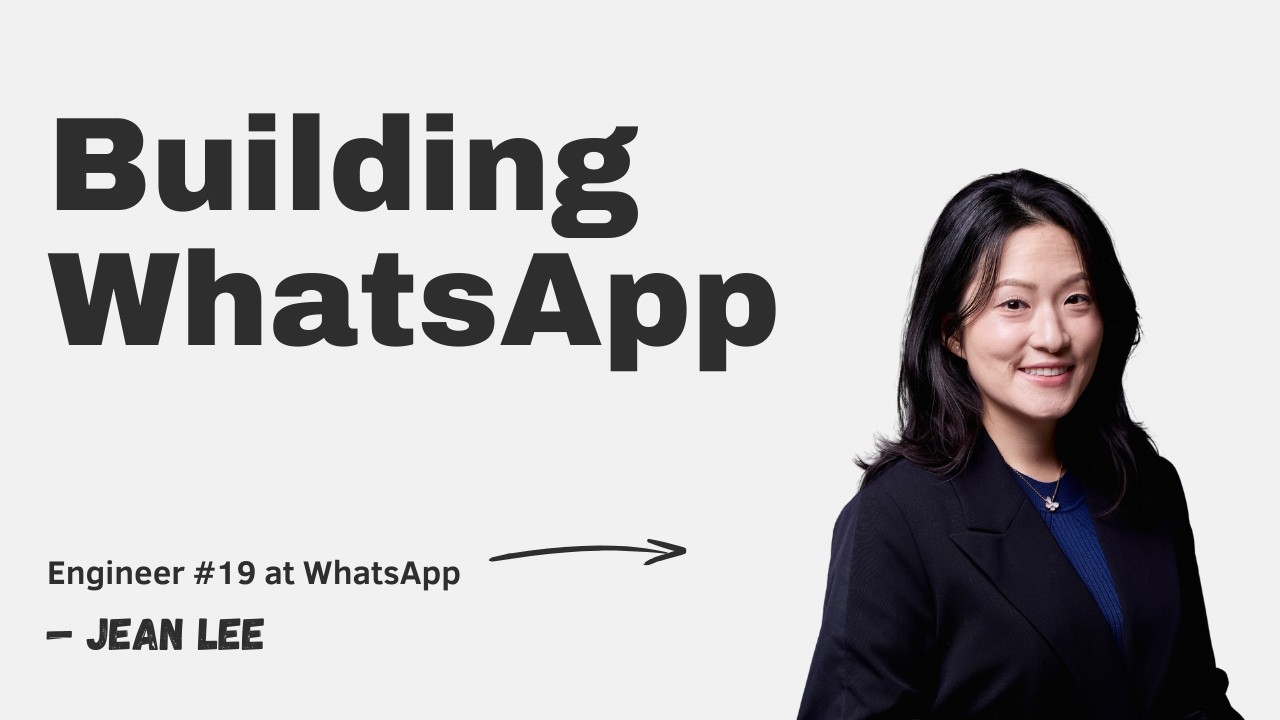
>> [music] >> Jean Lee was engineer number 19 at WhatsApp. She joined when hardly anyone in the US had heard of it, saw it [music] grow to 450 million users, and was sitting at her desk with noise-canceling headphones on when news broke that Facebook bought them for 19 billion dollars. In today's conversation, we discuss [music] how WhatsApp built natively eight different platforms with a team of 30 engineers.
Why the founder said no to almost every feature request for years. How WhatsApp's team operated with no code reviews, no stand-ups, no sprint planning, [music] and many more. If you want to understand how a tiny team with almost no process built one of the most successful products in history, and what today's AI-native startups can still learn from them, this episode is for you. This episode is presented by Statsig, [music] the unified platform for flags, analytics, experiments, and more. Check out the show notes to learn more about them and our other season sponsors, Sonar and WorkOS.
Jean, welcome to the podcast. It is amazing to to meet you. You have quite the story, early engineer at at WhatsApp. But, before we get into WhatsApp, how did you get into tech?
I've always been a small-town girl. My dad was an OG hipster. He was really into brewing beer. So, he decided to get a PhD in beer. In beer? Yeah. In brewing. In brewing.
So, I moved to San Francisco in 1999, and that's when I got really exposed to all the different tech roles, like growing up, I didn't really even think about engineering as a job. Um of course, I used computers, and I thought it was really cool to be able to use Yahoo and search things online, but beyond that, my first exposure to Silicon Valley and tech came from living here. I got to meet a lot of people who work in tech. I dabbled around with coding when I was a teenager, but not too seriously. But, I did think it was really cool that you can just write a few lines, and they will just do things for you over and over and over. It was almost magical. I I loved the feeling of creating something that that actually runs, um and debugging something and fixing it, and it runs again. That that was really joyous, and I didn't really get into like super into coding until I went to college, but one of the reasons why I decided I wanted to go into coding was I talked to different people. So, I thought maybe I want to be a designer, maybe I want to be an architect, maybe I want to be an engineer. And I talked to different adults who work in the in the industry. After talking to a lot of adults, I realized people who are in tech were the only ones who were really excited about their jobs. So, in Silicon Valley, when you ask people, like tell me about your work, people are often very hopeful for the future and very proud of what they're building. Compared to when you ask adults that I spoke with, they were not so encouraging. They're like, "Oh, don't become an architect. Don't become a designer." So, that that was one of the influences
for me early on. I studied computer science at USC, and one of my first internships, actual like coding internships, was at a small company. It was a three-person startup started by one of the new grads from USC. And you'll probably understand it was a video sharing website.
>> [laughter] >> But, it was not like YouTube, but there were so many versions of YouTube back in the days before what YouTube was dominant, right? So, you probably remember dozens of these video sharing platforms.
>> And one of the issues of having so many options is that you have to be visiting 12 different sites to search for any things. So, we had a website where you can aggregate all the different types of videos from different sources. Which is actually kind of funny because lately I've been seeing a lot of AI platforms where you can just switch between the models. Very similar to that. Yeah. How did you get into IBM? I really loved working for a small three-person startup because I got to work with engineers We had engineers overseas in China. So, I got to work with them. I got to also do a little bit of coding myself, but I was coming up with the design docs like the the features list and I was calling a lot of the shots and I could also directly see the impact of my code immediately on the website. And I thought that type of ownership and speed and the visibility was really exciting that I get to see the the impact of my work immediately.
But, one thing I wish I had was a little bit more mentorship because we were all new grads and in college I felt like we were just shooting things to see what sticks.
And I thought maybe for my first job out of school, I would like a little bit more mentorship and training and I started looking at more bigger companies, more traditional companies and that's how I ended up at At the time it was literally the biggest company in the US. At what point did you decide that you wanted to leave or try out something else? Or did you even decide or something just came up? One of the reasons why I wanted to go to a more traditional company with more structure was so that I could get more mentorship and training and IBM was excellent for that. There were so many veterans, they had so much experience, and they were willing to share with me because they were 20, 30 years ahead of me, right?
But, one thing I really missed was the small team environment. It was just so big. There was a lot of meetings, a lot of process, and I I missed seeing the impact of my work.
I couldn't quite understand how my work was contributing to the overall company. So, then I decided to take some time off and explore and have some fun. Yeah, and on what time was this? What year was this? So, I started working in 2007, and I left by 2009, which was actually in retrospect, I was really brave because it was in the midst of economic downturn. My thought process at the time was I was only 22 or three, and I figured even if I take a year off, I can still catch up, which I did. And what what what happened from there? How did you eventually get to WhatsApp? That was years later, right? Yeah, so I took some time off to try out different like classes. I took a lot of classes. I did a little bit of Now nowadays you call it the gig work, but I I did [laughter] all kinds of work. So, whatever I needed to, you know, make a living um while taking all these classes and exploring and really finding out what like what kind of environment or what kind of career do I envision for myself. And after I took those time off, I decided that I want to go back to Silicon Valley, but this time I do for a startup, but maybe with people who are a little bit more experienced, maybe not new grads, and maybe not a three-person startup, but a little bit more stable startup where I can possibly get both the the autonomy and the the impact of the work, but also a little bit more mentoring because I was still in my 20s.
Okay, so how did you find this startup, which of course happened to be WhatsApp? In 2012, WhatsApp was still early. They started in 2009 and they did still have a lot of users, but they're mostly in Europe and in India. Um they were not very known in America. Were you a WhatsApp user back then? I was not, but my my wife and her friends were or or back then my you know my my my girlfriend, but so some of my friends were using it on and off. It was kind of starting to be big in Europe. It wasn't as massive just yet.
>> Exactly. Um I was lucky because I actually lived in New York for a little bit before moving here and a lot of people in New York were using it because it's an international hub. So I I had used a prod- product in the past and I saw the job posting on LinkedIn.
And then you applied? What was the interview like? I don't think we did any leak code until way way later until when we started hiring interns and new grads.
Most of the interviews were talking about I I guess you can call it system design interviews. We would talk about how would you design this? How would you design that? Like tell me about your past experience building this product.
And I recall talking to Jan about different messaging apps. And being Korean, I told him a lot about KakaoTalk and how it worked. Yeah, that was my interview. Just like that you you got an offer. I guess it's a startup, right? Things move fast. Like but I assume it must have been quick turnaround offer and then you have to decide, right? How did you decide that you're going to join this relatively unknown startup that is building some cool messaging that you kind of thought was cool, but there wasn't much information about that. In fact, their Glassdoor rating at the time I remember had a one star. It had one review, one star someone saying, "Oh, I don't like working here." or he Who knows if that was even a real employee, but that was their Glassdoor. Oh, that's so interesting. I don't remember looking
up I must have looked up Glassdoor, but like I was really lucky because I actually had another offer from a different company, but they were a little bit slow. One company was taking weeks to get you an offer letter.
Another founder closed the deal in person the very next day. Speed matters and not just in hiring. This leads us nicely to our season sponsor WorkOS. AI startups are reaching enterprise customers faster than ever, sometimes just months after launch. And in the moment that happens, their requirements change. Customers want SSO, SCIM, audit logs, and granular permissions before they'll deploy.
Building that infrastructure yourself takes months. WorkOS gives you APIs to ship it in days. Authentication, SSO, SCIM, RBAC, audit logs, and more all designed to integrate directly into your product. Skip the rebuild, keep shipping. Visit workos.com. And now let's get back to Jean and how that other company could not get her written offer as quickly as WhatsApp did.
It was not a startup, and they said, "Oh, hey, like you have my verbal offer. I am going to give you a written offer soon." But then it took them a while, and meanwhile um Jan called me a few days later after the interview, and he said, "Come into the office right like today or tomorrow." Yeah. And then he asked me, "What would it take for you to take the offer right now?" Love it. What did you say? I mean, I wasn't looking for that much. I mean, I was in my 20s, so I just told them, "Oh, like a few things I would like to have, then sure, I'll take the offer, and I saw and signed the offer the following day." And I did actually hear back from the other company on the first day I started WhatsApp.
They called me, and I was like, "Oh, I just started a new company." Hey, is that's it with startup if you move faster, or otherwise don't be surprised. So, you were engineer or you were
employee number 19 at WhatsApp, right? Was engineer number 19. >> Engineer number 19 at at at WhatsApp. And you told me something really interesting that you were the youngest person even though you were like by this time at your mid-mid 20s or or so. I thought about that. So, I recall there were about four of us under the age of 30.
So, I was not the youngest, but there were two people who were new grads. And then myself and one other person who were in our late 20s. But the other like 15 or so people above 30 at the start of which is kind of unheard. What what why do you think this was? This is so interesting. That is true.
Is it still rare nowadays? Like Good question. I I think these days it might not be as rare, by the way. I think so because I think I read some kind of statistics from investors that actually when they look at the success rates of startups, they found that older founders tend to do better.
Yeah. And and then WhatsApp, I guess you know, like Jan and and Brian, they they started this at like mid-30s or so after they spent like more than a decade working at Yahoo and other places.
>> Exactly. Yep. So, I I guess they must have been able to hire like their network whatnot. Yeah, the first 10 or so engineers, a lot of them came from Yahoo.
Some came from Europe. You mentioned the story when Jan reached out to you. Jan used to do that. He would just look up who is the expert in this field and reach out to people and we had a lot of contractors in Europe.
And then we had some like mostly from personal connection like from Stanford because Brian went to Stanford. And then we had some referrals from Sequoia because they invested in WhatsApp. It is just fascinating cuz the way we connected actually is is both of us know Jan. I mean, you've worked with him, but I I had an email in my inbox from him, I think 6 months before you joined WhatsApp where I got a message from him and saying, "Hey, I I built a Windows phone app at the time together with my brother called Cocktail Flow." And it was a beautiful Windows phone app and it was labeled career opportunity. So, what you're saying is there's a alternative timeline where if I said like yes, I'm interested which in hindsight if a founder reaches out, you probably should at least talk to them.
Don't make the mistake that I did which is just saying like I'm sorry, I'm busy. If I might have been a contractor from Europe. So, like this sounds like that that was a strategy and that was a smart strategy. Yeah, we had many contractors in Europe and they were all very experienced people. They were basically managing themselves. We had people all over the world working with us. What was the tech stack like at WhatsApp?
Before Jean walks us through one of the most unusual tech stacks in startup history, we're talking about eight platforms and a handful of engineers. Let's talk about keeping your code base healthy with our senior sponsor Sonar.
Sonar, the makers of SonarQube, helps you automate code review and verify the quality and security of your code across your entire stack so bugs don't make it to production whether you've got one platform or eight. As agents take over the development process, Sonar has introduced the agent-centered development cycle framework, ACD a new software development methodology designed for the unique scale and speed of AI-generated code. It's a move towards a more intentional four-stage loop that gives agents the guardrails they actually need. The four phases being guide.
First, agents need to understand the canvas on which they're being asked to create so that the output fits with what the developer and organization require. Generate. The LLM-based tool generates the code it believes will achieve the desired outcome within the right context. Verify.
Next, the agent is deliberately required to check its work ensuring that it actually achieves the desired outcomes and is reliable, maintainable, and secure. Solve. Finally, any issues identified are provided to a code repair agent to fix. To power this, Sonar has significantly strengthened its offering introducing products and capabilities like Sonar context augmentation, SonarQube agentic analysis, SonarQube architecture, and SonarQube remediation agent. Head to sonarsource.com/pragmatic to learn more about the latest with Sonar and how it's empowering organizations to embrace the agentic era. And with this, let's get back to Gene and all the different tech stacks that WhatsApp had.
We were actually pretty unique. I I don't think any startup ever really does this, but we had seven different stacks. We had I actually looked it up because it's hard to count them all.
We had of course everybody has iPhone and Android, but we also had BlackBerry and Windows Phone, which is also pretty common, but we also had uh Nokia S40 S60. We had a thing called KaiOS for a while, but not for a long time, and we had the web client. So, it's actually eight. So, so you have of course, you know, we know that iOS is Objective-C, Android was Java back in the day, and then all of these like the the BlackBerry, the Nokia, they all had I think Nokia was Symbian C++. They all had like their own different language.
And then we've not talked about the back end, right? >> Mhm, and the back end was Erlang. Erlang. Can you tell us about Erlang?
Because this that is one of the most exotic tech stack. I've heard Erlang in telecommunications context at Ericsson again in in Europe. It is popular with the telcos, but startup-wise, I'm not sure I heard anyone else use Erlang. You might be right. They do have a Erlang conference. I think it's called Erlang Factory. There's a really great talk by one of our engineers, Rick Reed, if you're interested in learning more about it, but >> Or or we'll put it in the show notes below.
>> Yeah, I'm I'm pretty sure that it's still on YouTube. I haven't looked at recently, but uh he gave a really great talk about why they started working with Erlang and then it was the perfect choice, and he he describes it as um trying to maintain the engine of an airplane while it's flying 24/7.
Because if you imagine like WhatsApp is so international, we can't take a break, right? We have to continuously keep running, and it's always busy. If someone's it's 8:00 a.m. somewhere in the world, right? And Erlang was a really robust language that it was really good at concurrencies.
And they stumbled upon it because they were using this other tool that happened to use Erlang and [clears throat] decided this is the perfect language. And I guess at the core of WhatsApp, what was the core engineering challenge?
Was it like so many messages being kind of coming in needing to be seated out and sent to different, you know, platforms? platforms. Yeah, that was one of the main challenges. Like for example, for New Year's or Christmas.
Because everyone's saying "Happy New Year" at the exact same moment, and that was always our big biggest challenges every year and we would celebrate "Hey, we didn't we didn't go down after New Year's." So the the interesting thing about the
seven different mobile platforms specifically is the conventional wisdom wisdom before and after has been like look, if you want to support all those platforms, don't be silly. Do cross-platform either build your own layer that is cross-platform or use, you know, there's all sorts of frameworks.
Why did WhatsApp not do this? Do you remember the discussions of like why why hire seven including some really hard to hire people like for Nokia and Symbian and you mentioned the contractors in Europe. I mean, it sounds a bit of a nightmare. Why? And so Jan used to always say, "I want a grandma in a remote countryside to be able to use our app." So what does that mean?
They may not have the newest iPhone, the shiniest phone with the biggest memory, right? In the countryside where a grandma is using it, you need the app to be lightweight. You need it to work on any kind of device.
And you need the app to be simple. So those were our goals and priorities and that's the thought process that went into our decision to build seven different platforms. And then inside WhatsApp, how did you get things done? Do you remember like how a project got done or what was the concept of projects and kind of what engineering processes people might have followed especially, you know, later you worked at that meta compared to like how you know, like more kind of you know, standard startups work cuz I have a feeling WhatsApp was not exactly a standard startup, was it?
Not really. Um even meta compared to other big tech especially when I was at meta was pretty scrappy. I like not so much on writing documents for example. So the move fast and break things model kind of allowed them to be a little bit more lean in terms of their process um at least while I was there. But WhatsApp was like the ultimate lean company. By the time we were acquired we only had 20 something engineers so under 30 people serving 450 million monthly active users.
So we didn't have code reviews. The only time I got my code reviewed was the first time I made a commit Brian asked to take a look at it before I committed it and he asked me a bunch of questions which I had to think through a lot like a kind of like a coding interview. But that that was it. After first time we didn't really have a formal code review, but I mean people read the get commits because there's only 30 engineers so you can read other people's code and they would discuss it on the WhatsApp groups.
So everyone was trusted all engineers that they just pushed their code to they merged it into production, pushed it to production without a manager review and it was trusted that you know, they would ask if they were unsure or something like that.
>> Exactly. Okay, and it worked. It worked. What about the release process? Like if if if you tell me 450 million people, the first thing I'm going to say is like,
okay, did you do canarying? Did you do feature flagging? Did you do experiments? Did you do you know, what kind of safety nets did you have, right? We didn't do much of that but we were really big on dog fooding. So, every time we were about to do a release, we would all internally use it ourselves.
Jan, I think he might still say it on his LinkedIn. If you look up Jan, he's said just quality engineer. His title, when he messaged me cuz I didn't know he was CEO, it said chief QA officer.
>> [laughter] >> And I didn't know what that meant. I thought it was some sort of weird joke uh from the outside. So, now it makes sense. So, he he he he
was going around. He was making sure that it worked. He would try to break things as much as he can. And then if he finds a bug, he will like really try to break it, and then he'll come to and say, "Hey, like I found this bug." And you also said that Jan said no a lot. He did say no almost as I recall 99% of the time he was saying no.
Which I thought as a again as a young engineer, I was very confused because when you look at all these other apps, there were like dozen different messaging apps at the time. Like WeChat is notorious for having everything, right? They have so many features. And I was so confused like why don't we build all these features? They these are the newest coolest things that we should have because at the time when I joined, we didn't have groups. We launched groups shortly after I joined. We didn't have voice calls, video calls. We didn't have any of these no stories, you know, all the cool features were missing in my mind, but that was by design because we really wanted to prioritize again the quality of a grandma in a remote town being able to use our app at any given time. WhatsApp held back features for years until they were absolutely sure about quality. They worked on video calling long before they shipped it.
This leads us nicely to our presenting sponsor Statsig. Today, you don't have to choose between speed and confidence. Statsig lets you ship features behind flags, experiment with real users, and only roll out broadly when data shows that you're ready. Here's what it looks like in practice. You ship a change behind a feature gate, and you roll out gradually, say to 1% or 10% of users at first.
You watch what happens. Not just that it crashed, but what did it do to the metrics you care about? Conversion, retention, error rates, latency. If something looks off, you turn it off quickly. If it's trending the right way, you keep rolling it forward. And the key is how the measurement is part of the workflow. You're not switching between three tools and trying to match up segments and dashboards after the fact.
Feature flags, experiments, and analytics are in one place, using the same underlying user assignments and data. This is why teams at companies like Notion, Brex, and Atlassian use Statsig. Statsig has a generous free tier to get started, and pro pricing for teams starts at $150 per month. To learn more and get a 30-day enterprise trial, go to statsig.com/pragmatic.
With this, let's get back to how Jean and the WhatsApp team ship quality code with close to zero formal processes. So, it it sounds like WhatsApp had very, very little process. This was very, very interesting because when I worked at Skype at the same time as you joined WhatsApp, and and I also joined in 2013, I joined Skype, and you joined WhatsApp in 2012.
Skype was very proud that they sent everyone to a Scrum training. I was a Scrum Master, other people were Scrum Masters. So, here we were with all the Scrum, all the consultants, all the everything, and WhatsApp had defeated us with like a lot smaller team, and and no no Scrum, no TDD, no Agile.
>> at Skype? 1,000 engineers. >> Wow. That was a lot of people. Yep. I mean, when you have 1,000 people, you kind of need these.
Yeah, and and in all fairness, like, for example, one thing that this whole Scrum thing solved for a little bit is we had more more than 100 teams, and everyone was working on different things, and because of all this organization, we we had a prioritized list of which teams are the most important and those got all the support. So, I I guess one lesson might be that when you're just big it's just so much harder to move fast and a small team can outcompete you. Yeah, it just takes a long time even just to communicate with everyone. Being inside of WhatsApp, how did it feel to see this massive growth not in your team size but but in the product usage, the you know, the people, the media, the feedback? We didn't have much media.
Like nobody knew about WhatsApp. One interesting thing you told me about the office is you had countdown this place. Can you tell me about them? What were these? What did they display? Yeah, so you you asked me a lot about metrics and I think the really the only metrics we track like we didn't really pay too much attention to media or Skype's usage numbers or other messaging apps usage numbers, but the one metric we counted down was number of days like X number of days since the last outage.
Wow. No pressure. >> [laughter] >> Well, the numbers had to go up over time. Maybe that helped to have it visibly there. And when an outage happened, do you remember what happened after because these days in the tech industry it's all about blameless postmortems. If an outage happens, you know, we first mitigated then we get together then we write a document where we try really hard to not say who push caused this but we come up with why the system is like this and so on. How did you go about like dealing with outages and also following up and ensuring that they don't they won't happen again?
Today I know they did these discussions in the server group chats, but I wasn't in the server group chats so I can't really say for sure. I mean, for sure we did not have documentations. It sounds like a lot of things were pretty simple.
You talk with people, if you have a problem you try to fix it. Don't over document things for no reason and it seemed to just work. And and then have the key thing like if I guess if you put out days since since outage, people will know like, okay, I should do what I can to not have an outage. And everybody knew exactly who was working on what, so we didn't have to blame anyone. Everyone just knew. WhatsApp was a massive massive massive success. What do you think made it so successful in the early years and in the especially for for for the product itself, you know, you've seen Kakao, you were you were aware of the some of the competing messaging app. What did WhatsApp do that others did not? There is a little bit of the network effect.
If you It's like the thing about messaging app is that if you use it, you need your friends to use it, and if your friends use it, you need to use it. And WhatsApp was the first to be on the market. That certainly helped, but there was a lot of competition. But again, I think um a lot of other apps and messaging apps were chasing features.
Thinking about adding the the shiniest newest features. Whereas WhatsApp was very intentional. They actually worked on video calling for a very long time. We were probably working on it by the time you joined Skype when your founder said, "We have video." Um we were working on it, but we just didn't launch it until much later when we were actually like 100% sure about the quality of the the feature.
So, we often held onto features until we felt really sure before launching them. Interesting, cuz that is a little bit of a different than the conventional advice, which is if you're a startup, launch early, get feedback, improve it, and iterate it. Sounds like you did the opposite. It's It's like polish it and then do when you have full conviction.
Yeah, we did use it internally. Internally, we used the voice and the video calling features with our families. So, we had like a list, okay, like I have family members, these are all my my parents and my brother and sisters numbers. Let's enable it for this beta group, and we used it for a very long time before we launched it with the public. Two years into working at WhatsApp in 2014, Facebook announces their biggest ever acquisition, WhatsApp for 19 billion dollars. What do you remember of this time? How unexpected was it and and what what what kind of feelings what kind of emotions went through you and the team around you?
I actually journaled soon after the acquisition, so I looked at my journal around this time 2014. So, it's been over 10 years. But, I looked at my journal and I remember I was coding. I had this Spotify playlist with noise-canceling headphones. I had this playlist called let me think. This is the one I I listen to when I want to focus.
And again, like we were in a pretty small office where I can see everything. I was sitting in pretty central location, so I I could see people bustling and hustling, which which was a little bit weird, but I tried to tune it out so I can code.
>> [laughter] >> But then, from the side I saw um Neeraj, who was the head of business at the time. He was just like waving his arms.
He's He's a pretty tall guy, so I could see it. He's like like stop whatever you're working on right now. Come into the um we had one meeting room. Come in.
>> [laughter] >> Come into the meeting room. And I was like, what is happening? Like we never have meetings. Like we we never >> [laughter] >> So, you didn't have meetings? I mean, we we have scheduled meetings every now and then, but we rarely have like we we have never had unscheduled meetings. And we rarely have meetings at all.
So, I was confused and I I dropped whatever I was working on and I went into the conference room. And then they asked like turn off your phones. WhatsApp, turn off your phone. That That's kind of weird, right? And I thought, oh my gosh, what's happening?
Like did we go out of business? >> [laughter] >> That was one thought. I thought, are we getting another raise of fund like round of funding? Like a new investor coming on board. It can't be that we sold the company because Jan used to say he will never sell the company.
He used to actually say selling your company is like selling your baby. And I remember we were waiting for quite a while because there was one person missing. Oh. And it turns out she was getting her eyebrows done.
>> [laughter] >> With your phone, like by the way. Yeah, she came she came after the announcement, but the news was about to hit the public and they wanted to tell us before the news hit. And I I noticed that Jan and Brian were making this what face and I couldn't tell what it was. And then they made the announcement WhatsApp has been acquired by Facebook for $19 billion and I'm I realized oh, that was them trying to hide their excitement.
That was the face. >> kind of smiley but not smiley. >> [laughter] >> And that that was a really exciting moment and I I kind of zoned out for a little bit because I was trying to remember hey, like how many shares did I get?
Like they were again it was my first startup ever. I didn't even negotiate my equity and I honestly couldn't remember how much equity I had and I was trying to think how much is a billion dollars?
It seems like a lot of money. And how much is like 1% of 19 billion? I couldn't do the math. And I I remember sitting there thinking like trying to do the math. And then I thought, you know, no matter how the math works, I think one thing is clear. I'm going to be rich.
>> [laughter] >> And then Zuckerberg walked in. It's it's Zuckerberg walked in, sat in a meeting. >> Yeah. Wow. And then you had like a Q&A or something.
>> We did. We did. Yeah. What what kind of questions can you ask at that at this point? Or what kind of questions did people ask? There was a a mix of excitement and nervousness, right? Um, are we going to have to change everything like because I think a lot of the engineers were more experienced and they talked about how when Yahoo acquired companies, they changed 100% and lost the What is it? The essence of the business.
So there there were a lot of questions around that and Mark is actually very charismatic in person and he I thought he had great answers at the time. He made sure everyone feels assured that nothing's going to change and he will try to maintain it as much as possible. At least that was the messaging at the time. Clearly this this was an amazing exit and to this day it's not really been repeated. May- maybe a few companies might have come close but definitely not with with such a such a small team. How did you and and and your colleagues deal with the fact that wow, you've just got an amazing financial exit but I guess the company kind of continues inside of Meta like it it seems seems like you know, two things at the same time like okay, I have this like amazing financial exit but there's also work. How how do you balance? How did you balance? How do you decide what next? That's twofold.
So the the finance side in terms of that aspect, we actually got a lot of support. Our business person organized many meetings with like the accountants or even a financial advisor. We invited a a professor who was a founder of Wealthfront and he gave us an hour of uh finance advice and he recommended books. Um I read the Random Walk Down Wall Street, which is a great book. I recommend that people read it if you're interested in financial management and I read several other books to really educate myself to be able to manage this new wealth that I I came across as a young 29-year-old. Yeah.
What changed in the day-to-day once you officially became part of Facebook? Did you have to move offices? Did, you know, did you get a new title added to like the the meta org chart, that kind of stuff? The changes were very slow in the beginning. We didn't even move into the meta, or at the time was called Facebook, headquarters, Menlo Park, until at least a couple years after the acquisition. So, in the beginning, everything was same as usual. We still had our old office. Oh, we did actually move to a little bit nicer office, a slightly bigger office.
But other than that, it was business as usual. It was Jan and Brian. And we were hiring, but not, you know, at our similar like slow, steady pace.
Um and I think not until when we actually moved into the Facebook office, we started seeing a little bit more um cultural influence and merging. Like, we started using their like HR services, their recruiting services, and things like that. But it was a very gradual change over time.
And then when WhatsApp became part of Facebook, as I understand it it it's still is even to this day its own organization like inside of Facebook. I understand there's organizations like Messenger or like there's the Facebook group etc. So, like did WhatsApp remain its own kind of organization a little bit shielded from the rest of Facebook?
We had our own area. Yeah, or your own what? >> And in the beginning, we even had like our our own chairs and our own whatever like walls and decorations that we were using, we brought them all over.
But over time, you know, there was more and more mixing. After the acquisition, how did you start to hire more people? How did the projects change? Did things become more ambitious? Did you start to add more features? Cuz clearly like you were about 30 of you and then few in a few years there was hundreds of people working on WhatsApp these days it must be thousands of people. And like what would those people like what were new work came up cuz again originally WhatsApp was so minimalist, right? And kind of so scrappy. I guess we were choosing to be small not that there was not enough work for us to do, right? So one of the reasons why we also tried to remain small was actually Brian and Jan did not want to raise too much money.
And it actually cost a lot of money to serve so many users. You have to pay for the servers. You have to pay for the SMS registration codes. Every year Jan and Brian would do uh all hands meeting. So we did have meetings. Once a year?
Uh and Brian was very transparent. He would walk through our earnings and expenses. Ooh, interesting. >> well I had a lot of information around it. So the three main buckets of our spending was server cost was about a third and then about a third on salaries for the engineers mostly. And then a third uh the rest was for the SMS fee.
The when you try to register you get that code and we have to pay that 10 cents or whatever how much it cost to send that international messaging. Uh those numbers I mean they add up when you have millions of people using your app. So they actually didn't want to grow too fast because it gets very expensive. WhatsApp was free for the first year and then after that WhatsApp
was charging $1 for every year. But they were only using it in certain countries really to suppress growth because they didn't want to grow too fast. Fascinating. Cuz I I remember in in in Europe and in the US there was this $1 cost which I think people were like yeah, well whatever. I don't think we realized that that this was a growth suppression tactic. Fascinating. And then when Facebook acquired I guess they got rid of it. Yeah, Facebook said we don't need the dollar. We can grow as much as we can because they had the funding for it.
>> growth just did it did it speed up? Do you remember? It did, yeah. Incredible detail. You're using payment to slow down growth. A lesser known detail about the $1 is that that $1 was enough to pay for all of these, the server cost, the salaries, and the SMS code. Per per year. So, you were roughly break even.
Break even. We did have funding from Sequoia, but we never touched that money. Incredible. Yeah, Brian explained it as how his dad was a business owner and they would wake up in the middle of of the night worried, "What if I cannot pay the the salaries for the employees tomorrow?" And he he explained that he took the funding from Sequoia as like a backup.
And I think it was $8 million of funding if I recall, if I looked at the looked at the backup. Yeah, so we never touched that money. The $1 paid for everything.
And it slowed down growth enough to be manageable. Yeah. When you joined Facebook, what what title did you get and how did your career change? So, the thing about Facebook is that everyone's actually software engineer. I'm pretty sure they still don't have titles. They don't have titles, but they have levels.
What what what level did you come in at? So, being one of the five youngest people, I got I got leveled as a junior engineer. No, you did not.
L3 or L4? L3 L3, yeah. No. >> to like climb climb all over again. Oh my gosh, that that must have been a bit awkward. I was not too happy about it, but what's the alternative? Do I want to give up vesting the rest of the shares?
And eventually I got promoted. But that was within WhatsApp, so you got promoted pretty quickly. How many times did you get promoted there? A few times. I mean, I eventually became an engineering manager. And then, as you became an engineering manager, at some point you decided to help and start a new office in London.
How did that decision come, and how did you go about it? That was actually an ask from Facebook headquarters. So, they said, "Hey, like, we're actually running out of space in Menlo Park. And also, WhatsApp is so big in Europe, so why not have a presence there? It'll be much easier to hire engineers because everybody actually uses WhatsApp. So, let's let's start a new office there, and we didn't have that many engineering managers, right? I was very lucky because I got asked to go along with couple other engineering managers, and all three of us actually became managers around the same time. We actually even trained together. So, we were relatively new managers when we got asked to go there, but I think we were the only ones who could go because, you know, people have children, and they have to think about school, and they they couldn't go.
I remember one, the director that I was working with, he couldn't go because his wife says she doesn't want to move with the children. It It makes perfect sense.
You arrived in London, you landed with these two or three other engineering managers. How did you start to grow the office? From a practical perspective, what can I imagine? Like, you know, like, how did you start hiring or leasing space? Or what are the other things that you had to do that, you know, like, were maybe a little bit unexpected for you? A lot of the logistical part was taken care of for us because Facebook already had an office there, so we kind of moved in.
>> [laughter] >> We got our own section. And it wasn't big because at the time, again, we had a lot of contractors in Europe, so we had one contractor already in England.
So, we turned we converted them full-time, and then we had one in Scotland. We also converted him full-time, so he would commute from Scotland every now and then. So, we had two engineers plus three managers, and we started hiring there.
I think the hiring part was something that took longer to set up. We worked very closely with the Facebook hiring team, which was really great that we already had people who were familiar with the the local recruiting logistics there. So, one thing we focused on a lot was really letting engineers know, "Hey, WhatsApp is hiring in Europe now. Come apply." Because we were hiring from all over Europe and also a lot from India.
Do you feel it was easier to hire for WhatsApp in Europe just because people knew about it? Did you get more excitement, more applicants? 100%.
>> [laughter] >> You wouldn't believe. Like, I used to do a lot of university recruiting and when I used to go to Stanford, maybe 2013, like anytime before the acquisition, I would say, "Hey, like the people would come up to the booth." And I would say, "Hey, do you want to give me your resume?" And they would be like, "Tell me about your company first." >> [laughter] >> Because they have they have never heard of WhatsApp. What is this company? I'm not even going to give you my resume.
>> only have one resume. I have only 20 of these. >> Exactly. [laughter] Uh versus in Europe, people were actually excited to talk to us. What were the good and bad things of working in what basically is a remote office?
Like, yes, London was a big office, but HQ was in California, Menlo Park. That's 8 hours of time zone difference, a lot less overlap. There's probably some good things about this and some downsides. It helped because the three of us were from Menlo Park and we actually had great relationships with other teams and other engineers and other managers. And we also traveled back to Menlo Park every quarter and then we had the leadership from Menlo Park also travel to London almost every quarter. So, there was a lot of back and forth um to really strengthen the relationship in the beginning. Your your growth went to like being, I guess, the one of the most junior people in WhatsApp, which is crazy to say cuz you were experienced as well, but then you were also L3 in
Facebook, which I still cannot believe. But you you you went and became a manager. What pushed you to actually say, "I actually want to try to manage people?" I actually never asked for it myself.
Someone on my team begged my manager, "Hey, can I please report to Jean?" And that's how I became a manager. Wow. Okay. What do you think this this person
saw in you that they they wanted to report you when you were not a manager? I was the tech lead, so I was already managing the project. So, it was sort of a natural transition for me. And when you become a manager, what parts of the job came naturally to you and what parts were hard that you had to learn or get mentorship for? You know, I started reading books. I love reading books.
Whenever there's a new challenge, I like to read, learn, and research. There actually at the time weren't a lot of courses on how to become a manager. And not a lot of books. Like, I still don't think there are too many books about how to become a manager. There's a little bit more now. There there's like three or four good ones, but but they all came out after like 2015 or 2016. Yeah, the the resources were pretty limited, but I I did what I can to read as much as I can about leadership and I think I read actually a lot about communication and psychology. There's several books like I love the book Surrounded by Idiots. Have you read that book? It talks about the the DISC personality, the different types of personalities. And I try to really understand like what motivates people, how do you communicate with people in a in a way that makes sense to the other person. And also I reflected personally like what were some good managers and bad manager in my experience because you hear the saying that people don't leave companies, they leave managers, right?
Your manager can really break or make your career. And they can make your life miserable if you're, you know, matched with someone you don't vibe with. What are the traits that you found like as you recalled, what were things you said like I think this makes a good manager, I want to do more of that, and I think these were terrible managers or bad managers and I want to avoid doing that.
Do you remember some things that stuck out? Yeah, I tried to really understand each individual person. So, for example, like one person that I had on my team really loves going deep into problems or debugging and finding out how to improve things, right? Whereas another person really loves building new features.
And you cannot ask this person who loves to build new features to go debug 10 bugs, and that person will go nuts, right? And then I want person who was really good at uh building new features was not so great at mentoring new colleagues. So, I try to really look for their strengths and of course you also want to set them up for challenges so they can learn as well, but you want to balance them out.
So, I I try to really understand by asking them a lot of questions to understand like how do they want to be challenged? When do they feel excited about their work? Or what are the things that they're really good at? What are the things they want to improve on? So, I spent a lot of time really talking to them. As a manager, you were part of calibration meetings, right? Now that you're not at not at WhatsApp, not at Meta, can we talk honestly about what are those meetings like?
Uh you know, what are maybe the the good things about them? How how can you prepare? And what's the kind of reality? Cuz I feel outside of a small group of managers who are in there, it's not many people know like how how these things go. So, people number one biggest mistake people make is they think your manager is the one giving you a promotion or a salary boost. Like as a manager, middle manager, right? Like I have no authority to give you a promotion. You have no budget. Typically directors have a discretionary budget and sometimes to be able to give a reward, but not even a promotion they even they cannot give, right? Right. And um the bonuses are tied to your performance review, right? So at Meta, for every level there's exact percentages lined up by the comp team.
Like I have no control over it. The only control I have is I think of myself as the lawyer representing my clients. Wow, [laughter] yeah. I'm making a case for them. Yeah. Why they deserve to get a certain performance review rating or a promotion. And obviously like I want my clients to do well. I want my team to get, you know, the recognition that they deserve because I know they worked hard.
But it's not up to me. All the other managers also have to agree. That is the the nature of performance reviews. And being specific on a performance review, like who were the people that you saw, the engineers who got these high performance reviews from this committee? What kind of taxes did you see? What were there things were like, well, some managers kind of like, you know, politics where they kind of like they're calling in favors for each other and pushing someone up or or was it mostly meritocracy meaning this engineer was actually doing great work that a lot of managers saw and they just naturally agreed that, you know, this person who's on on Jean's team is actually they should be above my great person and I kind of agree with that. Cuz cuz there's bucketing, right? Like let's say there's bucketing, you're going to have buckets and you you need to put like, I don't know, X people in the top bucket, middle bucket, bottom bucket, and so on.
Yeah, when I was coaching engineers, so I learned that different companies have different ways of self-promotion. So, like for example, I heard some companies use emails. Like, they send mass emails every time they do a new release or launch.
Or like at WhatsApp, we use WhatsApp groups for everything. But at Facebook, they used Facebook Workplace, which is like Facebook groups where you have a group for team or your org and you're like everything has a different group.
And I noticed as I'm representing my clients during performance reviews, the people who post the most often, who have the most visibility, usually get the easiest consensus.
Because it's just like all very natural. Like, if I have no clue what you worked on and your manager tells me you're great, maybe, but how would I know? I don't I don't know anything about you.
So, it I'm less likely to be inclined to agree with your manager. Maybe your manager's right, but I don't know. Whereas, if you have been actively posting and telling me indirectly or directly what type of work you have done and what type of impact that has made and what are the lessons that you've learned and what type of people you work with, then I already know, "Oh, okay." Like, when your manager tells me you're ready, then I I say, I say, "Yeah." >> in turn we'll this was actually like it's it's more than just groups. It was like this Facebook feed where, you know, like it's a bit like LinkedIn, right?
Just to make it so so you see these posts come across the company and sometimes you'll put it like and what you're saying is like if you've seen this post from this engineer on some other team saying, "Oh, we've launched this feature. Here's an interesting thing we've learned that we're using for Facebook." And I hit like, I now remember it. And then when performance review comes, I go, "Oh, I remember that person. They wrote that." Exactly. And I might even have some questions, right? Maybe like if your manager tells me, I might be like, "Well, what about this? What about that?" But if you make a post, I can just ask you directly through the comments, right? There's a lot of engagement happening in the comments.
So, I might ask, "Have you thought about this other thing? Have you thought about this thing?" And you might give me answers, and I think, "Oh, okay. Yeah, he's thought about it. He's really good." It's amusing because it sounds like simplifying a little bit, but to be successful at Facebook, you need to also be good inside of the Facebook app and and do interesting work and and not hide it. Actually, make it visible. Mhm.
That's interesting. Now, stepping up a step back, uh and you were a manager at Facebook, you saw a lot of engineers. Outside of the performance you had and people posting about it, what traits did the the best engineers that you remember share? Like, what made them so good? I I struggle with this question a little bit because there's a difference between Like, how do you measure skill?
How do you measure what a good engineer is? Is a good engineer someone who can bang out new features? Is a good engineer someone who can design a complicated system? Is a good engineer someone who can communicate all of this and explain it to non-technical people?
I I struggle a little bit with the definition of a good engineer because I can have a definition of a good engineer, but it may be different for every culture. A different company might have different definitions. A good one. At Facebook, what was the definition? I remember that a lot of it went down to just a very simple characteristic, impact, right?
Definitely. And I think the way like there are many ways to measure impact, and definitely at Facebook their way of measuring impact was through these posts.
If I know about your work and you tell me you have impact, and I agree that's impact. So, going back to when you were in London office and and startup grow, at what point did the London office start to feel less of a startup a scrappy startup and more of a big tech? I remember a time after about a year and half or so, I realized I don't know who that person is or I don't know their name.
That was a turning point. Mhm. And at what point did you actually start to think of leaving Facebook? I I think I really enjoyed the intimate environment. So, I appreciate being able to like at WhatsApp with 30 engineers, I knew everyone's names, I knew where everybody lived, I knew their spouses and their children and their dogs' names, right?
>> [laughter] >> I really like that type of intimate environment. Um we still hang out and we have a pretty strong bond. And I feel like when when I even when I don't even know this person's name, I I just feel less connected. Yeah. So, so what was this the point where you decided that maybe it's time for you to leave and do something else? Also, okay, I was um in London on a contract. So, I had a 2-year contract. They said, "Hey, like go start this office." And then once the contract ended, I had the option to either stay there to continue working in the London office or I could come back to Menlo Park.
But then at that point I had been working there for 8 years and I honestly I think I was pretty burned out. I'm the type of personality who likes to get like A+ on everything I do every single time.
Yeah. So, it was pretty uh tiring after 8 years. I needed a break. Yeah. And when you left WhatsApp, what did you decide to do?
What I say WhatsApp, but it was Facebook at that point. >> Yeah. Um I actually because I know my personality, I don't take breaks.
>> [laughter] >> So, I actually had a goal. It's so simple, but I said, "I will do nothing for the next 6 months. I'm going to challenge myself to do nothing for 6 months." Did you manage?
I did it. I did it. I did read a lot. I exercise. I went on long walks. I did multiple meditation retreats. But that that was my challenge to myself to not work for 6 months. So, after 6 months of successfully doing nothing, after setting yourself that goal, what did you do to figure out what next? So, initially I thought maybe I want to go start a new company or join another startup because I like working. I love building things. So, I decided okay, I'm going to start talking to other founders or people who are hiring or people who are looking to start a new company. So, I I actually talked to 100 founders. I have a spreadsheet. Wow. To really see like is there any interesting opportunities that I might feel passionate about joining or building.
And then after talking to 100 startups, I realized I wasn't really passionate about joining any of them. And I thought like what would I feel more passionate about and what was the thing that I liked the most about working at WhatsApp for the past 8 years. And I realized I actually really liked being a manager because I felt like I was creating a culture of like support so that other people can really be learning and thriving and you know, be able to do things freely without people breathing down your neck. Or there are many things that make for a happy career, but I found it really um gratifying to be able to find that from each person and really try to help them out and create whatever that is. It might be different for different people and trying to unblock them so they can really flourish. And I thought well, if that's what I really want to do, I don't have to start a new company. I'll just do that part. So, I started exploring like mentoring people. Um I did a little bit of coaching. I don't do anymore and making videos on YouTube, writing, um all of that to see how how would I find the best way to support other people?
And on on YouTube and on LinkedIn you have been sharing a lot of your learnings, your observations. What what pushed you to to just start sharing way more of that than before? Like I I think you started to do this publicly after you left Facebook. I was actually writing a blog about this.
>> [laughter] >> So I actually just hit 100k subscribers on YouTube like last week. Thank you. Um and I was reflecting I almost gave up doing YouTube because I was really not comfortable being seen in public. And I I I've been thinking a lot about this like my grandma's from North Korea. She escaped during the war and in that culture like you are you do not speak publicly.
Um you don't want to be seen because it's dangerous. And I think there's generations of that still kind of installed in me. The the fear of speaking up is real. I felt really uncomfortable. So I almost stopped doing YouTube.
Uh once one of my videos went viral from early on and I felt really uncomfortable. But luckily I was talking to a mentor of mine and she said, "Hey, it's okay to do something that you enjoy doing. Just give it a shot." So then I I stuck with it. I'm so glad I did.
Speaking of the thing that is happening of course right now AI. You you spoke about this on on your YouTube channel as well. But from your your vantage point, how is AI changing how engineers work, how managers work? I do find it really interesting how with AI we're seeing smaller teams emerge. I know that a lot of teams are saying, "Well, we're small because of AI." But I wonder if it's independent from AI. When you're small, you're just more efficient. Because WhatsApp did not use AI.
But we were efficient because we were small. And I almost feel that even today I can't cannot really point to too many teams that are as small as WhatsApp and have that kind of impact. Maybe Anthropic might come to mind, but I think even they're bigger.
So I I wonder if if there is a maybe just going back to basics with all of this. Maybe AI allows to do the way most companies would have wished they operated. Yeah, and I think there's also a shift in the mindset. Like I remember back in the days people when you go to networking events, people would brag about, "Oh, like we've hired like a thousand new engineers or we're growing at X times bigger." And that was like a point of brag. And investors also thought that was a good thing. You need to grow. You need to hire more engineer. That was a sign of healthy engineering environment. Whereas nowadays investors actually think smaller is better, right? Like they don't necessarily push you to hire more people. And I think as a byproduct of hiring less people and staying lean, they have found this new found efficiency and they happen to equate it with AI. Although AI I think it's clear it makes engineers a lot more efficient in well we think it makes them efficient because it can generate a lot of code. You can work on more things parallel as happening with agents.
How are you seeing the role of software engineers change and also the role of engineering managers? Yeah, I mean I love AI tools. I use it every day as a thought partner. I I often ask ChatGPT, "Hey, like be my executive coach or be a Harvard-trained futurist and then help me find the next trends." Or you know, there are there are various ways of really using AI to its full potential. I feel like engineering management is less affected by AI because it it requires a lot of like people to people like asking questions and learning about your engineers.
AI can maybe help you with that, but I don't see AI replacing that part. But again, because the teams are much smaller, if you are the type of engineering manager who was doing a lot of these like OKR and process and writing documentation, a lot of that part is going to be gone. And I'm kind of glad it it will be gone because I I don't think it's really necessary. Yeah, for example, a lot of performance management of you know, gathering the impact, it can probably be done by asking agents to gather all these things. I remember as an engineering manager, I used to go through gathering all the work that my engineers have done. So on the calibration meeting, I could fairly represent them.
And then turns out that the managers who showed up without doing that, I had an advantage. But that was not fair for the engineers, by the way, right? Maybe [clears throat] I will get rid of this advantage. Yeah, AI will do a lot of the the grunt work, more tedious work that maybe engineering managers or even software engineers had to do manually back in the days. Like we had an engineer who was just there to add comments.
And that is something AI can do really well. If you had to give career advice to a new grad who says, "I would like to build a durable career in software engineering in this kind of AI native world, what would you suggest they focus on?" I say foundations.
You know, tools come and go, languages come and go, but foundations don't go anywhere. We mentioned that WhatsApp that's WhatsApp was very small, very efficient.
What do you think today's AI or like AI native startups could still learn from WhatsApp? That made WhatsApp successful and it probably helped them as well. I think of AI so like we went through several trends. Like when I first got my first internship I ever had
was a video sharing website and I've seen how there were dozens of video sharing websites and how the ecosystem changed over time. And then I saw what what WhatsApp there were dozens of other messaging app competitors and how that kind of settled down over time. I think we're living through something similar.
There are so many new AI startups and new tools and so easy to get distracted by all the different options and it can feel quite overwhelming. There are too many options and you can feel the decision paralysis. But really again, go back to the core foundation. Think about like if you're builder, think about what you're building, why you're building. If you're learning, think about why you're learning, what you want to learn. And if you have clear goals of what where you want to go, it will really ground you because otherwise you're just going to be all over the place and you might work really hard and end up nowhere. Did I understand correctly that you're saying that WhatsApp was successful because the goal was clear? Jan said no to the distractions and all all the ideas, but was very thorough in watching, whereas all the other competitors, even all the messaging apps, they got distracted building, "Oh, let's do like all this cool video feature. Let's do stories.
Let's do all of these things." They got some traction and they did a lot of these things, but WhatsApp was very good at doing the core thing well and then slowly adding things that were value added. Is that a fair summary? Yeah. And also I noticed this when I started advising and coaching uh startup founders as well. And also for any engineers who want to join new startups, this is great way to evaluate new founders. Like some founders, if you're the opposite of Jan and say no to things, um the I call it removing distractions, right? You're prioritizing ruthlessly.
If you're the opposite of that, imagine what type of startup you end up. You say yes to everything. Maybe it might feel really nice as a 20-something-year-old if I were to go back in time and I go to the founder with all my great ideas and he says, "That's a great idea, Jean.
Let's build it." But imagine like he said that to every single idea that I had, the company will be all over the place. In terms of the long-term growth, it's not a very ideal situation. So, looking back, what are some kind of like pre-AI or not as modern practices that you did at WhatsApp that were really good that today's very modern AI native teams or whoever could benefit from?
Yeah, uh several things come to my mind. I think one of it is by having lean teams, you get several benefits. You get to remove a lot of the distractions in process, and through that you get two really incredible benefits, which is ownership and the the really like the freedom to build things.
Right? Because Jan was always like Jan and Brian were always very specific about what we're building. But, how we're building it was up to debate, right? I had mentioned earlier that the only time we did a actual code review was the first time I
made my Git commit, uh Brian reviewed my code and asked me a bunch of questions. So, Jan and Brian were both like so technically adept, they were really excellent at doing this. They would ask, "We're trying to achieve this. Like, what is the problem here? Or what is the best way to solve this issue? What are like different ways we can approach this? Tell me." So, so do I understand correctly that of course the small teams helped with a lot of things, but then having the founders push people they hire, especially early on, they almost like push them to excellence, right? Is it fair to say that by Brian doing that super detailed code review with you the first time, it it upped your game, and
later he didn't even have to do anything, right? Yeah, and there's like multi-fold, right? Like, one is to really challenge me to think critically, and then I took I learned a lot just from that conversation. And then also like from then on he never checked my code again.
So I know I am responsible, right? And I do believe when you give responsibilities to people, people will step up. May not everyone.
>> [laughter] >> But most people will. But I think this might be a bit underrated. I I wonder if we've had a little bit of too over-babying of engineers. I I remember for a long time there was a talk in the you know, in the past 5 to 10 years and the as engineering managers like, "Well, I have a new grad. It will take them months to onboard. I need to assign them a mentor for at least 6 months, maybe even a year." And were we over-babying these very capable adults? You know, they're adults, right? It even if even if they're 18, but they're typically 20-something because they came out of college and they're hungry and they're ambitious and maybe we don't need to do this much of it.
Always. Yeah, I think as long as you hire smart people, it's kind of like a mold, right? If you make a mold too small, that's that's the limit of how far they will grow. Yeah, if the mold is too small, you have to throw away a lot of things that could have made excellent material. And finally, you're a reader.
What are some books that you would recommend for software engineers or people wanting to grow professionally or in a personal sense? I love reading books. I did So while I I challenged myself to do
nothing, I actually read I I actually took a year, but I did read 100 books during that time. That was my doing nothing. Anyways, it kind of depends on what your goals are, but you gave me some specific things like for your career, I think for me what was really helpful was What Color Is Your Parachute?
That helped me really understand my strengths and my goals and priorities in my career and life. I mentioned the book Surrounded by Idiots. I know the title's kind of funny, but it's an excellent book if you want to learn more about how to really communicate and work with different people. If you want to understand finance, I mentioned earlier the Random Walk Down Wall Street. It's a great book for understanding how to manage your money. Yeah, I I would recommend those books to start with.
>> Any fiction books? Hunger Games was one of my favorite books. I I read the whole series. I read it as well and I I almost like the I like the movies as well, but I love the books.
>> Yeah, yeah. I love the story of like this woman overcoming her challenges. And everyone else and winning in the end. Several times.
>> [laughter] >> Well, Jean, thank you so much. Yeah, thank you. Thank you for having me on the channel. This was a great conversation.
>> Yeah. I hope you enjoyed this rare conversation with Jean. One thing that stuck with me was Jean's point about why WhatsApp had almost no process and why it worked. Processes exist for audits, for accountability, and for tracking who did what. But when you have 30 people and everyone can see what everyone else is working on, you don't really need a paper trail. You just walk over and talk. This is a good reminder that most processes exist to solve problems that are created by scale [music] and not by the work itself. found the Skype contrast really surprising.
[music] A thousand engineers, Scrum certifications, two-week sprints, and a dedicated Scrum Master for every team. I was one of them at Skype. And WhatsApp with 30 people and zero formal methodology was shipping faster and growing faster on every metric [music] that mattered. This is a much-needed reminder that organizational discipline and actual shipping speed are just not the same thing. And I was in the middle of this at Skype and Jean was at in the middle of it in WhatsApp. [music] Finally, it was interesting, as a former manager, to hear how Jean described performance reviews as a manager herself. She described herself as a lawyer representing her clients. As in, she doesn't control the promotion, she just makes the case. And the engineers who had the easiest time getting promoted were not necessarily the best engineers. They were the ones who made their work visible. They posted about their launches in the internal Facebook workplace. They engaged in comments, answer questions publicly, and the managers in those calibration rooms are making decisions about people that they might have never worked with directly.
So, visibility is not just vanity. [music] It's how the system inside larger companies actually works. This is an uncomfortable truth, but I think every engineer at a big company needs to hear it. If you've enjoyed this podcast, please do subscribe on your favorite podcast platform and on YouTube. A special thank you if you also leave a rating [music] on the show. Thanks, and see you in the next one.