[00:00] (0.64s)
Go for it, dude.
[00:01] (1.76s)
>> Whoa, whoa, whoa, whoa, whoa. Are they
[00:03] (3.44s)
going to try to give this cougar a shot?
[00:06] (6.48s)
Like with a needle.
[00:09] (9.36s)
>> I don't think he's going to like that.
[00:11] (11.44s)
Aren't they scared? That fence is the
[00:13] (13.84s)
only thing keeping them apart. H,
[00:16] (16.96s)
actually, we might need to rewind a
[00:18] (18.96s)
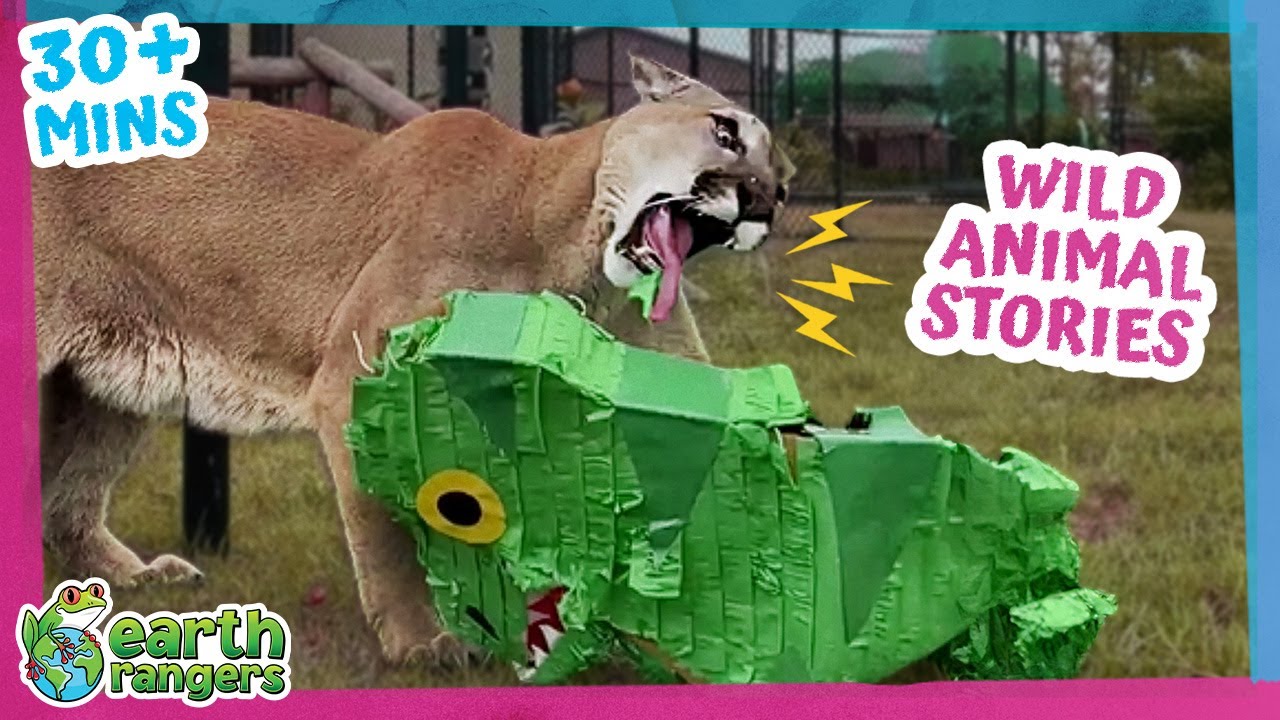
little bit. This is Charlie the Cougar.
[00:21] (21.92s)
When he was just a baby, someone took
[00:24] (24.40s)
him out of his home in the wild and
[00:26] (26.32s)
tried to sell him as a pet. Cougars
[00:28] (28.48s)
might start out as [music] tiny as house
[00:30] (30.56s)
cats, but they are not meant to be pets.
[00:33] (33.60s)
But luckily, he was rescued and brought
[00:36] (36.40s)
to a sanctuary in California. The team
[00:38] (38.96s)
at the sanctuary wanted to release him
[00:40] (40.96s)
back to [music] the wild, but there was
[00:42] (42.88s)
a huge problem. The people who' cougar
[00:45] (45.92s)
napped him [music] had removed his claws
[00:48] (48.96s)
permanently.
[00:50] (50.48s)
That meant he'd never be able to hunt or
[00:53] (53.05s)
[music] protect himself in the wild. So,
[00:55] (55.60s)
where was Charlie going to go? Good
[00:58] (58.00s)
thing there [music] are animals saving
[00:59] (59.84s)
heroes like the people at Bush Wildlife
[01:02] (62.64s)
Sanctuary in Florida. They found [music]
[01:04] (64.88s)
out about Charlie and offered to take
[01:06] (66.96s)
care of him and maybe even teach him a
[01:09] (69.43s)
[music] few tricks, but we'll get to
[01:10] (70.96s)
that later. First, they had to deal with
[01:13] (73.28s)
a new problem. Charlie, he wasn't as
[01:16] (76.72s)
tiny as a house cat anymore. Now, he was
[01:20] (80.08s)
huge. That meant they'd have to drive a
[01:23] (83.20s)
fully grown cougar all the way across
[01:26] (86.08s)
the United States. I bet he was asking
[01:28] (88.72s)
to stop for snacks the [music] whole
[01:30] (90.08s)
way. It was a long journey, but at last,
[01:34] (94.00s)
Charlie arrived at his [music] new home.
[01:36] (96.72s)
Bush Wildlife Sanctuary was already
[01:39] (99.20s)
filled with all sorts of animals like
[01:42] (102.00s)
bears, owls, bobcats,
[01:45] (105.76s)
and another cougar [music] named Tomla
[01:49] (109.28s)
who was a little suspicious about having
[01:51] (111.68s)
a roommate.
[01:53] (113.92s)
H [music] Tomla was pretty used to being
[01:57] (117.20s)
the big cougar on campus, spending all
[02:00] (120.24s)
day lounging, [music] playing with his
[02:02] (122.80s)
human friends, and having all the cougar
[02:06] (126.42s)
[music] toys to himself, like his
[02:09] (129.12s)
cardboard box. Oh, and the traffic
[02:11] (131.66s)
[music] cone. Sometimes he even got a
[02:14] (134.48s)
pumpkin. [gasps]
[02:16] (136.24s)
He wasn't going to have to share his
[02:17] (137.36s)
pumpkin, was he? Tamala didn't have to
[02:20] (140.16s)
worry. There were plenty [music] of toys
[02:22] (142.72s)
and attention and even pumpkins to go
[02:25] (145.52s)
around. He realized that Charlie [music]
[02:28] (148.00s)
wasn't going to cramp his style at all.
[02:30] (150.16s)
He could actually be a friend. Tomla
[02:33] (153.12s)
decided to show him the ropes like this
[02:35] (155.28s)
one. Before long, Charlie was feeling
[02:38] (158.40s)
comfortable in his new home, which meant
[02:40] (160.48s)
[music] it was time to get serious. The
[02:43] (163.12s)
sanctuary workers needed to teach
[02:45] (165.12s)
Charlie some tricks. It's going to look
[02:47] (167.84s)
like everyone is having fun, but I I
[02:49] (169.60s)
promise this is serious. They wanted
[02:51] (171.61s)
[music] to train Charlie to get him used
[02:53] (173.76s)
to listening to humans. Wild cougars
[02:56] (176.20s)
[music]
[02:56] (176.72s)
don't usually let people tell them what
[02:59] (179.12s)
to do. Which is why if you see one in
[03:01] (181.44s)
the woods, you can't just say, "Excuse
[03:03] (183.84s)
me, please don't eat me." Oh, you don't
[03:06] (186.32s)
want to be eaten? My mistake. I won't
[03:08] (188.32s)
gobble you up. I'll go find myself a
[03:10] (190.64s)
delicious hamburger instead. Not exactly
[03:13] (193.23s)
[music] how that's going to go. The team
[03:15] (195.92s)
started with something called target
[03:17] (197.68s)
training. No, no, no, no, no. Not that
[03:20] (200.32s)
kind of target. But it's still really
[03:22] (202.64s)
cool. [music] They taught him that when
[03:24] (204.56s)
they point here, Charlie goes there.
[03:27] (207.84s)
Pretty soon, no matter where they
[03:29] (209.44s)
pointed, [music] Charlie listened. But
[03:31] (211.68s)
it gets better. Look,
[03:33] (213.60s)
>> Charlie, sit.
[03:34] (214.72s)
>> He can sit and go up and down. He's
[03:39] (219.92s)
better [music] trained than my dog. M.
[03:42] (222.56s)
>> But that's not the most amazing thing
[03:45] (225.04s)
they taught him. Every year, the animals
[03:47] (227.52s)
all need to get checkups, which means
[03:50] (230.08s)
humans have to be around them, getting
[03:52] (232.24s)
up close and personal. Again, not
[03:54] (234.64s)
something cougars are usually cool with.
[03:57] (237.44s)
But Charlie's training went so well that
[03:59] (239.92s)
he started to really trust his handlers.
[04:02] (242.72s)
But would he trust them enough [music]
[04:04] (244.56s)
to let them give him a shot? Like with a
[04:07] (247.44s)
needle? I don't even like getting shots.
[04:10] (250.56s)
Who does? No, I can't watch. Okay, maybe
[04:14] (254.16s)
I can. I [music] got to know if this is
[04:15] (255.76s)
going to happen. Is he really going to
[04:17] (257.28s)
let them do it without even complaining?
[04:21] (261.44s)
>> Yay! OH MY GOODNESS. GOOD JOB.
[04:25] (265.04s)
>> OKAY, maybe he complained a teeny bit,
[04:27] (267.28s)
but still, that's incredible. Charlie's
[04:30] (270.64s)
been at Bush Wildlife for a whole year
[04:32] (272.96s)
now, and he's doing better than ever. To
[04:36] (276.16s)
celebrate his anniversary, they got him
[04:38] (278.32s)
his very own pinata. Don't be jealous,
[04:41] (281.52s)
Tomla. And even though he's got a few
[04:43] (283.92s)
tricks up his sleeve, he still feels
[04:46] (286.32s)
wild, which means he's going to be
[04:48] (288.20s)
[music] happy and healthy for a long
[04:50] (290.72s)
time to come. All thanks to these
[04:52] (292.79s)
[music] amazing animals saving heroes.
[04:56] (296.16s)
You can help animals, too. Check out the
[04:58] (298.56s)
Earth Rangers Act [music] to learn more
[05:00] (300.16s)
about how you can protect animals and
[05:02] (302.40s)
the planet. Animals will thank you, just
[05:05] (305.44s)
like Charlie thanks his heroes [music]
[05:07] (307.36s)
every day. Okay. What is happening here,
[05:10] (310.96s)
Earth Rangers? Those [music] vets are
[05:13] (313.44s)
putting some kind of goo on that
[05:15] (315.68s)
turtle's shell. Is it toothpaste? Nah,
[05:19] (319.76s)
turtles don't have teeth. And that's
[05:22] (322.26s)
[music] not his mouth. Wait, I know what
[05:25] (325.04s)
that stuff is. It's beeswax. Is this
[05:28] (328.48s)
turtle going undercover? Maybe as a
[05:30] (330.96s)
candle. No, they must be doing it for
[05:34] (334.40s)
some other reason. But why? Let's solve
[05:37] (337.68s)
this turtle mystery by going [music]
[05:39] (339.36s)
back to the beginning.
[05:43] (343.12s)
The New England Wildlife Centers see all
[05:45] (345.76s)
kinds of animals coming through their
[05:47] (347.68s)
doors, especially turtles.
[05:51] (351.44s)
>> No, wait. Sorry. That's a tortoise.
[05:54] (354.48s)
That's a turtle. Careful. That's a
[05:57] (357.36s)
snapping turtle.
[05:59] (359.36s)
Turtles arrive at the animal hospital
[06:01] (361.52s)
with all sorts of problems. Some have
[06:04] (364.88s)
hooks in them. Poor guy. Some need
[06:08] (368.16s)
medicine for their colds, and many have
[06:11] (371.68s)
broken shells,
[06:13] (373.84s)
often from cars, because people put
[06:16] (376.08s)
roads right through the middle of their
[06:17] (377.76s)
habitat. That's called habitat
[06:20] (380.08s)
fragmentation, and it's a real problem.
[06:23] (383.28s)
It's also why I have to slam the brakes
[06:25] (385.44s)
on this video to tell you something
[06:27] (387.36s)
super important. We need more Earth
[06:30] (390.08s)
Rangers like you to help us protect
[06:31] (391.92s)
turtles and [music] other wildlife. If
[06:34] (394.08s)
you want to join the team, ask your
[06:35] (395.92s)
parents to download the Earth Rangers
[06:37] (397.68s)
app. The turtles need you. Okay, back to
[06:40] (400.88s)
the story.
[06:42] (402.96s)
That looks painful. Wait, are they
[06:46] (406.40s)
they're putting beeswax on the cracked
[06:48] (408.72s)
parts? But why do that? Is the wax just
[06:52] (412.64s)
a [music] patch? No, there must be more
[06:54] (414.88s)
to it than that. But what? Also,
[06:58] (418.56s)
wouldn't it be easier if we took the
[07:00] (420.56s)
turtle out of his shell? Well, I hate to
[07:03] (423.44s)
be the one to break it to you, but
[07:05] (425.44s)
that's not how it works. A turtle's
[07:07] (427.92s)
shell is part of its body. It doesn't
[07:10] (430.64s)
come off. And turtles with cracked
[07:13] (433.04s)
shells can't survive in the wild. Ooh,
[07:16] (436.64s)
candy. No thanks. I'm in the middle of
[07:18] (438.88s)
this video. Oh, that's the beeswax. But
[07:23] (443.44s)
how does it go from that to that? Oh,
[07:27] (447.37s)
[screaming]
[07:28] (448.24s)
it's got to be melted.
[07:31] (451.28s)
That was quick. Once the pellets are
[07:33] (453.26s)
[music] melted, the team gets stirring.
[07:36] (456.08s)
And so much stirring until the wax is
[07:39] (459.52s)
nice and sticky. Next, they roll the wax
[07:42] (462.40s)
into a ball just like clay and put it on
[07:45] (465.44s)
the cracks in the turtle [music] shell
[07:46] (466.96s)
to keep the injury clean and dry. But
[07:50] (470.32s)
why can't they just use a bandage? It's
[07:53] (473.28s)
because turtles like to hang out
[07:55] (475.04s)
underwater. And beeswax is waterproof.
[07:58] (478.64s)
It doesn't get soggy like a regular
[08:00] (480.72s)
bandage would. Plus, there's a bonus.
[08:04] (484.00s)
The beeswax also contains honey, which
[08:06] (486.96s)
has been used as medicine since ancient
[08:09] (489.44s)
times. But does it actually help?
[08:13] (493.36s)
Healing takes time. So, to find out, we
[08:16] (496.00s)
need a turtle who's had the [music] wax
[08:17] (497.44s)
on for a while. Let's just peel this
[08:22] (502.00s)
That looks so good. A little more
[08:25] (505.12s)
healing time and you'll be ready to go
[08:27] (507.36s)
back home. Like this guy who came in
[08:31] (511.04s)
looking like this. Got a turtle healing
[08:34] (514.08s)
beeswax treatment and now looks like
[08:37] (517.20s)
this. Have fun. I hope you never have to
[08:40] (520.32s)
come back like this turtle did. She was
[08:43] (523.92s)
released a year ago and just became
[08:45] (525.97s)
[music] a patient again. Don't worry.
[08:48] (528.96s)
It's nothing the team can't handle. Look
[08:51] (531.44s)
at her shell now. Sure, it's not as good
[08:54] (534.24s)
as new, but that's an incredible
[08:56] (536.56s)
recovery considering this is what she
[08:58] (538.56s)
looked like when [music] she got here.
[09:00] (540.32s)
Beeswax really is amazing. The New
[09:04] (544.08s)
England [music] Wildlife Centers have
[09:05] (545.76s)
saved so many turtles with it. I guess
[09:09] (549.04s)
it just goes [music] to show that
[09:10] (550.48s)
sometimes sticky problems call for
[09:12] (552.96s)
stickier solutions.
[09:16] (556.64s)
Wait, I know what that bird is saying.
[09:19] (559.20s)
It's a crane warning cry. But where's
[09:22] (562.64s)
the danger? Uh-oh. It's a black bear.
[09:25] (565.93s)
[music] And he's headed this way. I'd be
[09:29] (569.36s)
squawking, too, if I were him. Wait,
[09:32] (572.24s)
that bear is all the way on the other
[09:34] (574.48s)
side of the lake. So, why is this bird
[09:36] (576.72s)
freaking out? Oh, yeah. Bears can swim.
[09:41] (581.20s)
And this one's getting closer and closer
[09:44] (584.88s)
and closer. Run, Mr. Crane. Run. I mean,
[09:49] (589.28s)
fly. fly.
[09:51] (591.52s)
Why isn't he flying away?
[09:54] (594.16s)
Get out of there, bird. Maybe we better
[09:57] (597.68s)
rewind.
[10:00] (600.80s)
Welcome to Yellowstone National Park.
[10:03] (603.76s)
This is Floating Island Lake. That
[10:06] (606.64s)
island, not even real, just a floating
[10:09] (609.36s)
blob of [music] plants. But birds love
[10:11] (611.92s)
it. It's also where this story starts. A
[10:15] (615.36s)
couple of months ago, a pair of [music]
[10:17] (617.12s)
sandill cranes decided to nest here and
[10:20] (620.64s)
had two fuzzy babies. Hello, baby
[10:24] (624.32s)
cranes. That's the magic of wetlands.
[10:27] (627.60s)
They're perfect [music] places for
[10:28] (628.80s)
animals to raise families.
[10:31] (631.60s)
Which is why I need to slam the brakes
[10:33] (633.60s)
on this video to tell you something
[10:35] (635.20s)
super important. Wetlands everywhere are
[10:38] (638.08s)
shrinking, [music] and we need more
[10:39] (639.68s)
Earth Rangers like you to help protect
[10:41] (641.68s)
them. Get the Earth Rangers app to find
[10:44] (644.00s)
out how you can help. Now, back to the
[10:46] (646.48s)
story. [music]
[10:47] (647.60s)
You know what else is great about living
[10:49] (649.04s)
on floating island? It's harder for most
[10:51] (651.52s)
predators [music] to get to you. Most
[10:54] (654.00s)
predators. But sometimes you got to
[10:56] (656.80s)
leave the island to find food, which
[10:59] (659.12s)
means swimming to shore. And as soon as
[11:02] (662.32s)
the babies were big enough, that's what
[11:04] (664.16s)
they did. While the family feeds, Dad
[11:07] (667.20s)
keeps an eye out for danger.
[11:10] (670.32s)
A red-winged blackbird. Is he an enemy?
[11:13] (673.44s)
Nope. He's just protecting [music] his
[11:15] (675.52s)
family. The cranes got a little too
[11:17] (677.84s)
close to his nest, so he's [music]
[11:19] (679.28s)
trying to scare them away. Crane dad is
[11:21] (681.68s)
like, "Chill out, fellow bird.
[11:24] (684.08s)
Blackbirds might not be a problem for
[11:25] (685.92s)
sandill cranes." But a bear definitely
[11:28] (688.96s)
could be, like the one who keeps getting
[11:31] (691.52s)
closer. But I still don't get it. Why
[11:34] (694.24s)
aren't the cranes flying away? Unless
[11:38] (698.72s)
the babies can't fly yet, they're still
[11:41] (701.36s)
too young. And dad's not just going to
[11:44] (704.00s)
leave his kids behind, which means he
[11:46] (706.88s)
has to face the bear. This crane weighs
[11:49] (709.92s)
what? 10 lb. That bear weighs hundreds.
[11:54] (714.24s)
Oh, I can't watch.
[11:56] (716.72s)
Hold up. Is this crane charging the
[12:00] (720.40s)
bear? I did not see that coming. And
[12:03] (723.44s)
neither did the bear because it's
[12:05] (725.68s)
totally freaking him out. Cran dad's
[12:08] (728.24s)
like, "You better run, bear. I know
[12:10] (730.96s)
karate." Hi. Looks like this bird's
[12:14] (734.08s)
using [music] a classic animal defense
[12:16] (736.00s)
strategy. Look scary. Hope it works. And
[12:19] (739.68s)
the bear's falling for it. He's climbing
[12:22] (742.08s)
a tree. That's right. This giant bear is
[12:26] (746.64s)
hiding from a bird. That bear's like,
[12:30] (750.72s)
"Nope, nope, nope, nope, nope. I don't
[12:32] (752.80s)
believe it. The bear is running away.
[12:36] (756.16s)
Crane dad one, bear zero. I guess you
[12:40] (760.00s)
can never underestimate what animals
[12:42] (762.16s)
will do to defend their babies. But
[12:45] (765.28s)
thanks to the gutsiest crane in
[12:47] (767.04s)
Yellowstone, [music] the chicks grew up
[12:49] (769.36s)
and learned to fly just in time to head
[12:52] (772.24s)
south [music] for the winter, leaving
[12:54] (774.00s)
behind memories and one very embarrassed
[13:00] (780.88s)
This grumpy furball is Bobby. He's a
[13:04] (784.00s)
bobcat with only three legs. And he's
[13:08] (788.08s)
trying to do something nearly
[13:09] (789.68s)
impossible. Get back to the wild. That's
[13:13] (793.60s)
where he lived until
[13:17] (797.12s)
he got hit by a car. When the rescuers
[13:20] (800.88s)
finally freed him, they could see his
[13:23] (803.44s)
leg was hurt and rushed him to the vet
[13:26] (806.32s)
for x-rays. Bobby's leg was broken in a
[13:30] (810.24s)
way that couldn't be fixed. And to
[13:32] (812.86s)
[music] save his life, the vet had to
[13:35] (815.36s)
surgically remove it. Bobby was really
[13:38] (818.96s)
scared. He was still a young bobcat. How
[13:42] (822.40s)
could he learn to do the things that
[13:44] (824.32s)
wild bobcats do to survive, like
[13:46] (826.96s)
climbing and catching food? He needed
[13:49] (829.84s)
help in a big way, which is why Bobby's
[13:53] (833.28s)
rescuer brought him to Tisha at Go Wild
[13:56] (836.64s)
Rehab. It's a special place where sick
[13:59] (839.52s)
and injured animals can get better and
[14:02] (842.00s)
hopefully someday go back to the wild.
[14:05] (845.92s)
But Bobby wasn't happy about being so
[14:08] (848.56s)
close to people. It's not personal. It's
[14:11] (851.76s)
just his wild nature. Bobcats might look
[14:14] (854.88s)
like big house cats, but they're not
[14:17] (857.20s)
pets. You got to keep your distance.
[14:20] (860.16s)
Tisha knew Bobby needed to start moving
[14:22] (862.64s)
again. So, she placed him in an extra-l
[14:25] (865.26s)
[music] large enclosure with multiple
[14:27] (867.20s)
levels and left him alone. But she kept
[14:30] (870.96s)
the security cameras on so we can see
[14:33] (873.36s)
what happened. For a long time, Bobby
[14:36] (876.64s)
didn't move at all. He was like, "Climb
[14:39] (879.44s)
and jump with only three legs? I don't
[14:42] (882.40s)
think so." But then he spotted something
[14:45] (885.68s)
he couldn't resist. A cardboard box.
[14:49] (889.44s)
Maybe if he was careful. It was just a
[14:52] (892.88s)
little jump.
[14:56] (896.72s)
Yes. Okay. Okay. Maybe bobcats and house
[15:00] (900.16s)
cats do have some things in common. It
[15:03] (903.52s)
was a little jump, but [music] a big
[15:05] (905.52s)
boost of confidence. And soon Bobby was
[15:08] (908.88s)
doing more climbing and pulling off
[15:11] (911.28s)
slightly bigger jumps.
[15:14] (914.08s)
But climbing a few platforms and jumping
[15:16] (916.48s)
into boxes wasn't the same as surviving
[15:19] (919.52s)
in the wild. Would he ever be ready to
[15:22] (922.24s)
go home? But what Bobby didn't know was
[15:25] (925.68s)
that someone special was coming to help
[15:28] (928.24s)
him. Betty. Betty was another young
[15:31] (931.92s)
bobcat who got hit by a car and had a
[15:34] (934.96s)
bad head injury. She needed time to
[15:37] (937.52s)
heal, too. So, her rescuer brought her
[15:40] (940.00s)
to Go Wild Rehab.
[15:42] (942.72s)
She was just as thrilled as Bobby. Then
[15:46] (946.56s)
Tisha had an idea. Maybe these two
[15:49] (949.52s)
bobcats could help each other by
[15:51] (951.84s)
becoming roommates. So Tisha moved them
[15:54] (954.72s)
both to a bigger enclosure outdoors.
[15:58] (958.32s)
Wait, was this a good idea? In the wild,
[16:01] (961.60s)
bobcats don't usually make friends, not
[16:04] (964.32s)
even with other bobcats. But Bobby and
[16:07] (967.28s)
Betty were both still young. Sharing
[16:09] (969.92s)
space with another animal would help
[16:12] (972.08s)
prepare them for the kinds of encounters
[16:14] (974.16s)
they'd face in the wild. Plus, seeing
[16:17] (977.12s)
Betty climbing around might encourage
[16:19] (979.36s)
Bobby to do the same. And Betty was a
[16:23] (983.04s)
climber. She climbed the walls, the big
[16:26] (986.00s)
tree branch. She even went to the
[16:28] (988.42s)
[music] top of the giant cat tower,
[16:31] (991.12s)
which is when Bobby realized that if he
[16:33] (993.60s)
wanted to go back to the wild, [music]
[16:35] (995.76s)
he had to become a climber, too.
[16:40] (1000.20s)
>> [music]
[16:42] (1002.32s)
>> Betty's like, "Did you see that?" But
[16:44] (1004.88s)
then something Tisha didn't expect to
[16:47] (1007.52s)
happen happened. Betty and Bobby became
[16:52] (1012.16s)
friends. I know. I know. I said bobcats
[16:55] (1015.44s)
don't usually make friends, but these
[16:57] (1017.84s)
two did with each other, not with anyone
[17:03] (1023.12s)
And after 8 months, Bobby was moving
[17:06] (1026.00s)
around just as good on [music] three
[17:08] (1028.00s)
legs as he did on four, which meant it
[17:11] (1031.12s)
was time for him to go home. When Tisho
[17:15] (1035.12s)
took him out [music] to the woods and
[17:16] (1036.56s)
opened his crate, he was gone in a
[17:19] (1039.20s)
flash. He didn't say goodbye, but he
[17:22] (1042.00s)
didn't growl at her either, which is as
[17:24] (1044.16s)
close to a thank [music] you as you can
[17:25] (1045.52s)
get with a bobcat.
[17:27] (1047.76s)
We didn't forget about you, Betty. She
[17:30] (1050.56s)
went back to the [music] wild just two
[17:32] (1052.48s)
weeks later. Who knows, maybe they'll
[17:35] (1055.20s)
find each other out there.
[17:37] (1057.76s)
This giant sea turtle just [music]
[17:39] (1059.36s)
escaped from danger. But she still
[17:41] (1061.68s)
needed serious help. And she wasn't the
[17:44] (1064.64s)
only one in trouble because a whole
[17:46] (1066.96s)
squad of police cars had just arrived
[17:49] (1069.84s)
with nine more injured turtles. What
[17:52] (1072.96s)
happened to all these sea turtles? I
[17:55] (1075.44s)
think we need to back up a bit.
[17:58] (1078.88s)
Last night, these wild sea turtles
[18:00] (1080.88s)
crawled onto the beach to lay their eggs
[18:04] (1084.08s)
when people tried to grab them. Stealing
[18:07] (1087.20s)
protected animals like sea turtles is
[18:09] (1089.36s)
called poaching. And it's against the
[18:11] (1091.52s)
law, Earth Rangers. But this time, the
[18:14] (1094.72s)
police showed up and caught the
[18:16] (1096.32s)
poachers. And thank [music] goodness
[18:18] (1098.16s)
they did because the poachers had been
[18:20] (1100.32s)
planning to sell the endangered sea
[18:22] (1102.24s)
turtles as food. Okay, stop the video
[18:26] (1106.24s)
for a second. Sea turtles aren't the
[18:28] (1108.48s)
only animals [music] that need
[18:29] (1109.60s)
protection. Wildlife everywhere needs
[18:32] (1112.00s)
heroes, and you can be one of them by
[18:34] (1114.56s)
becoming an Earth Ranger. Ask your
[18:36] (1116.80s)
parents to download [music] the Earth
[18:37] (1117.92s)
Rangers app so you can join the team.
[18:40] (1120.56s)
Okay, back to the story. The rescued sea
[18:43] (1123.44s)
turtles were in rough shape. Scratches
[18:46] (1126.00s)
on their shells, cuts on their fins. One
[18:49] (1129.44s)
had even been kept upside down [music]
[18:51] (1131.36s)
for hours, which is super dangerous
[18:54] (1134.00s)
because turtles can't breathe properly
[18:56] (1136.24s)
that way. So, the police rush the
[18:58] (1138.48s)
turtles straight to the jaguar rescue
[19:00] (1140.37s)
[music] center. The honorary Earth
[19:02] (1142.24s)
Rangers here help all kinds of animals,
[19:04] (1144.64s)
including sea turtles. Right away,
[19:06] (1146.92s)
[music] they placed the turtles into
[19:08] (1148.80s)
special turtle recovery pools. The pools
[19:11] (1151.68s)
would help calm the turtles until the
[19:13] (1153.36s)
vets could treat them. Wait, what's
[19:15] (1155.76s)
this? The police also brought turtle
[19:20] (1160.56s)
138 of them to be exact. Remember, the
[19:23] (1163.60s)
turtles were laying their eggs when the
[19:25] (1165.20s)
poachers showed up. And the poachers
[19:27] (1167.20s)
planned to sell the eggs as food, too.
[19:30] (1170.24s)
Those eggs were meant to hatch into baby
[19:32] (1172.56s)
turtles away from their nests. The eggs
[19:35] (1175.44s)
had almost no chance of hatching unless
[19:38] (1178.00s)
they could be placed in special
[19:39] (1179.28s)
incubators.
[19:40] (1180.80s)
And that was a big problem because the
[19:43] (1183.52s)
jaguar rescue center didn't have enough
[19:45] (1185.92s)
incubators for so many eggs. So they
[19:48] (1188.80s)
sent the eggs to some friends who did.
[19:51] (1191.12s)
Kawita Turtle Rescue just up the coast.
[19:54] (1194.16s)
Hopefully they could save some of the
[19:55] (1195.92s)
eggs while the jaguar team focused on
[19:58] (1198.00s)
the big turtles. The vets treated the
[20:00] (1200.64s)
turtles wounds and gently tucked them
[20:02] (1202.96s)
back into their recovery pools. The
[20:05] (1205.20s)
turtles were safe, but they belonged in
[20:07] (1207.52s)
the ocean, not pools. When could they go
[20:10] (1210.72s)
home? Were they going home? Don't worry,
[20:14] (1214.72s)
pool time was almost up. Over the next
[20:17] (1217.36s)
10 days, nine of the turtles were
[20:19] (1219.28s)
healthy enough [music] to be released,
[20:20] (1220.96s)
and huge crowds of honorary Earth
[20:23] (1223.12s)
Rangers showed up to cheer them on. They
[20:26] (1226.00s)
couldn't wait to get back to the sea.
[20:29] (1229.12s)
Bye, turtles. That left [music] just one
[20:31] (1231.68s)
last turtle waiting. She'd been injured
[20:34] (1234.40s)
worse than the others and needed a
[20:36] (1236.56s)
little more time to heal. But two weeks
[20:39] (1239.36s)
later, [music] she was ready. And an
[20:42] (1242.16s)
even bigger crowd showed up to cheer as
[20:44] (1244.48s)
she crawled into the ocean. But this
[20:47] (1247.20s)
rescue wasn't over yet. Remember the
[20:50] (1250.24s)
turtle eggs? The team at Kawita had kept
[20:52] (1252.88s)
them safe and warm for weeks until
[20:56] (1256.48s)
16 tiny turtles were born. This time,
[21:00] (1260.16s)
there wasn't a big crowd. Baby turtles
[21:02] (1262.72s)
need a clear, [music] obstacle-free path
[21:04] (1264.56s)
to the ocean so they don't get confused.
[21:07] (1267.36s)
But take my word for it, even without
[21:09] (1269.60s)
the cheering, it was just as amazing. It
[21:12] (1272.88s)
wasn't all 138. But even in the wild,
[21:16] (1276.32s)
not every sea turtle egg hatches. And in
[21:19] (1279.04s)
a rescue situation, saving even a few
[21:21] (1281.76s)
turtles is a big win. Uh, I think I'm
[21:25] (1285.36s)
experiencing turtle cuteness overload.
[21:28] (1288.72s)
That's 26 sea turtles who got a second
[21:31] (1291.36s)
chance, Earth Rangers. With numbers like
[21:33] (1293.68s)
those, the heroes at Jaguar Rescue
[21:35] (1295.84s)
Center totally deserve to be candidates
[21:38] (1298.00s)
for Earth Ranger of the Year.
[21:40] (1300.88s)
This dolphin is in trouble, Earth
[21:42] (1302.72s)
Rangers. And it's [music] up to these
[21:44] (1304.88s)
people to save his life.
[21:47] (1307.60s)
Earlier that day, that dolphin looked a
[21:50] (1310.40s)
little like this.
[21:52] (1312.56s)
What he and his buddies didn't realize
[21:55] (1315.04s)
was that they were headed into dangerous
[21:57] (1317.60s)
waters.
[21:59] (1319.60s)
Cape Cod Bay. Suddenly, they were
[22:02] (1322.88s)
surrounded by land on three sides, and
[22:05] (1325.84s)
echolocation wasn't going to help them
[22:08] (1328.24s)
find their way up. The calls they were
[22:10] (1330.72s)
using to navigate [music] got absorbed
[22:12] (1332.56s)
by the soft sloping shores. They were
[22:16] (1336.48s)
stuck. But that still didn't explain how
[22:19] (1339.12s)
this dolphin ended up on land.
[22:23] (1343.36s)
Where did all the water go? Well, the
[22:26] (1346.56s)
tide went out big time.
[22:29] (1349.84s)
As the dolphins were swimming, the water
[22:32] (1352.16s)
got shallower and shallower until it was
[22:35] (1355.52s)
gone, leaving them stranded. And even
[22:38] (1358.88s)
though dolphins breathe air, they were
[22:41] (1361.04s)
in big trouble. Dolphins can survive
[22:44] (1364.16s)
being [music] out of water, but only for
[22:46] (1366.00s)
a short time and only when cared for by
[22:49] (1369.04s)
experts. Thankfully, some experts were
[22:51] (1371.92s)
nearby. The International Fund for
[22:54] (1374.56s)
Animal Welfare, IA. These honorary Earth
[22:58] (1378.08s)
Rangers have teams all over the world
[23:00] (1380.64s)
helping keep animals safe. And with Cape
[23:03] (1383.76s)
Cod seeing more strandings of live
[23:05] (1385.92s)
dolphins than anywhere in the world,
[23:08] (1388.40s)
they were the heroes to call.
[23:11] (1391.76s)
One thing you need to know is that
[23:13] (1393.20s)
[music] dolphins are big. Common
[23:16] (1396.24s)
dolphins like this one can be up to 8 ft
[23:18] (1398.88s)
long and weigh 300 lb. That's as much as
[23:22] (1402.64s)
a refrigerator.
[23:24] (1404.96s)
So, how are we going to [music] move
[23:26] (1406.56s)
this dolphin? With a whole team of
[23:29] (1409.12s)
people. Remember, lift with your knees,
[23:32] (1412.32s)
not your back. 3 2 1 up. Dolphins are
[23:38] (1418.08s)
way too heavy to carry very [music] far.
[23:40] (1420.32s)
So, it's a good thing the IFA team had
[23:44] (1424.16s)
A dolphin [music] cart. It's a special
[23:46] (1426.80s)
rescue tool for moving heavy dolphins
[23:49] (1429.36s)
over land. There's [music] even space
[23:51] (1431.76s)
for two. Uh, team, where are you going?
[23:55] (1435.84s)
The water's the other way. Oh, right.
[23:59] (1439.28s)
The tide was out. These dolphins are
[24:02] (1442.08s)
going to need a ride to a safer place
[24:03] (1443.64s)
[music] with deeper waters.
[24:06] (1446.32s)
This was a job for Moby's
[24:09] (1449.36s)
mobile dolphin clinic. It's like an
[24:11] (1451.92s)
ambulance for dolphins, stocked with all
[24:14] (1454.64s)
the things the team needed. Dolphin
[24:18] (1458.80s)
blankets,
[24:20] (1460.48s)
room for up to 12 common dolphins, and
[24:23] (1463.76s)
even an ultrasound machine. Wa! Check it
[24:26] (1466.96s)
out. Scans like these [music] tell the
[24:28] (1468.96s)
team if the dolphins need more treatment
[24:30] (1470.64s)
at the rescue center or if they're ready
[24:32] (1472.64s)
to be released. For those [music] that
[24:34] (1474.80s)
were ready, these animals saving heroes
[24:37] (1477.36s)
needed to get them somewhere they
[24:38] (1478.80s)
wouldn't get stranded [music] again. The
[24:41] (1481.36s)
open ocean. That meant the farthest tip
[24:44] (1484.32s)
of Cape Cod. Herring Cove Beach.
[24:48] (1488.80s)
They got the dolphins set up on the
[24:50] (1490.56s)
sand. These tents aren't just for show.
[24:54] (1494.40s)
They keep the dolphins secure and out of
[24:56] (1496.88s)
the sun and wind. Hang in there, buddy.
[24:59] (1499.92s)
It won't be long now. The team moved the
[25:03] (1503.04s)
dolphin into the water, but he wasn't
[25:05] (1505.20s)
quite ready to be released yet. Hang on.
[25:08] (1508.56s)
Time for a better view. Everyone knows
[25:11] (1511.52s)
underwater is the best way to see a
[25:13] (1513.76s)
dolphin.
[25:16] (1516.56s)
Oh, he can't wait to get back home.
[25:19] (1519.92s)
First, the [music] team had to check out
[25:22] (1522.24s)
how he handled the water. He would tell
[25:24] (1524.72s)
them he was ready by pumping [music] his
[25:26] (1526.48s)
tail. Come on, you can do it. Was that a
[25:32] (1532.88s)
It was.
[25:34] (1534.72s)
Let's do this. Release time in 3 2 1 go.
[25:41] (1541.28s)
The dolphin was on his way home. The
[25:44] (1544.32s)
team did an amazing job [music] saving
[25:46] (1546.48s)
that dolphin and his friends. That's why
[25:49] (1549.36s)
I'm nominating for Earth Rangers [music]
[25:51] (1551.92s)
of the Year.
[25:54] (1554.40s)
A mystery bird. Yellow feathers, black
[25:58] (1558.16s)
mask, red eyes. Maybe he's some kind of
[26:01] (1561.44s)
canary or parakeet.
[26:04] (1564.32s)
What are you? Wait, I think that's his
[26:08] (1568.16s)
nest. Kind of looks like a basket. That
[26:11] (1571.52s)
could be a clue. What is he tearing
[26:15] (1575.92s)
apart his own nest? Why do you hate your
[26:20] (1580.24s)
house, Mr. Bird? I hope it's not because
[26:23] (1583.36s)
of termites. Nah, he's a bird. Bugs are
[26:27] (1587.60s)
basically his chips. So, why is he
[26:30] (1590.96s)
ripping it down?
[26:33] (1593.12s)
I really wish we knew what kind of bird
[26:35] (1595.04s)
this was. Hold up. What's he doing with
[26:38] (1598.48s)
that blade of grass? He's tying it onto
[26:42] (1602.16s)
that skinny branch and it's not coming
[26:45] (1605.68s)
undone. It's almost like he's weaving
[26:50] (1610.32s)
it. Wait, maybe he's part spider. A
[26:55] (1615.76s)
spider bird. Okay. No, that's
[26:59] (1619.12s)
ridiculous. You can't just mix species,
[27:02] (1622.56s)
can you? Okay. Weaving. Weaving.
[27:07] (1627.92s)
That's it. He's a weaver bird.
[27:11] (1631.68s)
A southern masked weaver to be exact.
[27:15] (1635.36s)
They're super common in southern Africa,
[27:17] (1637.92s)
which is uh right where we are right
[27:21] (1641.44s)
now. There are over a 100 species of
[27:25] (1645.12s)
weaver birds, and they're all famous for
[27:27] (1647.52s)
the same thing, building some of the
[27:30] (1650.24s)
most complicated nests in the world,
[27:35] (1655.28s)
and also possibly destroying them.
[27:37] (1657.92s)
Either way, they do it by shredding
[27:40] (1660.00s)
grass into strips and looping them
[27:42] (1662.64s)
together like they're weaving a basket.
[27:45] (1665.28s)
It's way harder than it looks. Humans
[27:48] (1668.72s)
have tried to copy them. Total fail.
[27:52] (1672.64s)
Advantage: Weaver Bird. But birds aren't
[27:56] (1676.16s)
the only master builders. Lots of
[27:58] (1678.64s)
animals make amazing homes. The problem
[28:01] (1681.20s)
is more and more are losing the safe
[28:03] (1683.44s)
spaces they need to build them. That's
[28:05] (1685.60s)
why Earth Rangers [music] work to
[28:07] (1687.20s)
protect animal habitats. And you can
[28:09] (1689.44s)
help, too. Just download the app. But I
[28:12] (1692.48s)
still don't get it. If we birds are so
[28:15] (1695.60s)
good at making nests, why did he tear
[28:18] (1698.64s)
his down? Ooh, look who just showed up.
[28:22] (1702.80s)
A female weaver bird. But she's not here
[28:25] (1705.84s)
to move in. She's here to do an
[28:28] (1708.40s)
inspection. You see, in the weaver bird
[28:31] (1711.12s)
world, dads do all the nest building,
[28:33] (1713.84s)
and the mom birds are super picky about
[28:36] (1716.40s)
where they lay their eggs. To attract a
[28:39] (1719.04s)
mate, you got to prove you can build a
[28:41] (1721.28s)
safe, strong nest.
[28:44] (1724.48s)
And it's got to be snake proof. That's
[28:47] (1727.44s)
why he builds way out on the skinny tips
[28:50] (1730.00s)
of branches. Easy to fly into, hard for
[28:53] (1733.76s)
snakes to reach. Grow some wings, you
[28:56] (1736.32s)
reptile. And he doesn't stop at just
[28:59] (1739.36s)
one. See that other nest over there?
[29:02] (1742.32s)
Yeah, he built that, too. It's a whole
[29:05] (1745.28s)
survival strategy. More nests equals
[29:08] (1748.56s)
more chances to impress. Wait, did I
[29:12] (1752.08s)
just do math? Finally, it's finished.
[29:16] (1756.24s)
But will she like it? Well, that's
[29:18] (1758.96s)
totally up to her. And if she's not
[29:21] (1761.20s)
impressed,
[29:22] (1762.72s)
rip it down. Start all over.
[29:25] (1765.92s)
Wait, that's why he demolished the first
[29:29] (1769.44s)
one. She didn't like it. I really hope
[29:32] (1772.96s)
this one gets a wings up. Then again, in
[29:35] (1775.72s)
[music] the weaver bird world, this is
[29:37] (1777.92s)
how you find love. One blade of grass at
[29:41] (1781.20s)
a time.
[29:43] (1783.04s)
Hey, Freddy. Uh, what you doing?
[29:49] (1789.12s)
Whoa. Whoa. That's too close.
[29:53] (1793.20s)
Sorry, Earth Rangers. My survival
[29:55] (1795.52s)
instincts kicked in. But we actually
[29:57] (1797.92s)
need Freddy this close. Even if she is
[30:01] (1801.04s)
an apex predator. Wait, we're sure about
[30:04] (1804.00s)
this, right?
[30:07] (1807.44s)
Okay, just checking. We need her this
[30:10] (1810.40s)
close [music] because we're about to see
[30:12] (1812.00s)
something super rare.
[30:18] (1818.16s)
A professional alligator tooth cleaning.
[30:21] (1821.12s)
Bet you didn't know alligators need
[30:23] (1823.04s)
that, did you? Ha, they don't.
[30:25] (1825.84s)
Alligators lose and grow new teeth all
[30:28] (1828.48s)
the time. They can go through 3,000
[30:31] (1831.60s)
teeth in their lifetime. So, why are we
[30:35] (1835.04s)
doing this? We'll get to that in a
[30:37] (1837.52s)
minute. First, I need to answer another
[30:39] (1839.76s)
question. How do we know Freddy's an
[30:42] (1842.72s)
alligator and not a crocodile?
[30:46] (1846.00s)
Easy. I'll show you. Uh, Freddy, you
[30:49] (1849.04s)
need to close your mouth. That's better.
[30:51] (1851.44s)
When Freddy closes her mouth, only her
[30:53] (1853.92s)
top teeth are showing. That makes her an
[30:57] (1857.36s)
alligator. Crocodiles show their top and
[31:00] (1860.96s)
bottom teeth. Also, crocodile snouts are
[31:04] (1864.32s)
V-shaped. And Freddy's snout is Stop.
[31:07] (1867.68s)
Stop. Stop. Personal space Freddy. There
[31:12] (1872.00s)
we go. U-shaped. Definitely an
[31:15] (1875.76s)
alligator. Either way, her teeth look
[31:18] (1878.56s)
pretty [music] sharp to me. And it still
[31:20] (1880.80s)
doesn't explain why these people are
[31:23] (1883.20s)
brushing an alligator's teeth. Okay.
[31:26] (1886.88s)
Okay. I'll tell you. It all started when
[31:28] (1888.96s)
Freddy was still in her egg and a person
[31:31] (1891.66s)
[music]
[31:32] (1892.64s)
cracked it open before she was ready to
[31:35] (1895.04s)
hatch. And that wasn't great for our
[31:37] (1897.76s)
poor Freddy. But to answer the most
[31:40] (1900.16s)
obvious question, yes, it's the reason
[31:43] (1903.68s)
she's so small. Oh, you didn't notice
[31:46] (1906.96s)
that? She should be like 8 ft long, but
[31:50] (1910.72s)
she's just 6 and 1/2. That's because she
[31:54] (1914.56s)
wasn't able to fully develop in her egg,
[31:57] (1917.76s)
which [music] led to brain and body
[31:59] (1919.84s)
problems and meant she couldn't survive
[32:02] (1922.48s)
in the wild. It's also how she ended up
[32:05] (1925.28s)
at Bush Wildlife Sanctuary. They're
[32:07] (1927.92s)
experts at helping sick and injured
[32:09] (1929.76s)
animals get better so they can [music]
[32:11] (1931.76s)
go back to the wild. And for the ones
[32:14] (1934.16s)
who can't be released, like Freddy, they
[32:16] (1936.96s)
get to live their best lives at the
[32:18] (1938.88s)
sanctuary. And when you're an alligator
[32:21] (1941.44s)
queen, it looks like this and this and
[32:25] (1945.28s)
this. Plus, food delivered right to your
[32:28] (1948.96s)
mouth. But back to the teeth. The real
[32:32] (1952.80s)
reason they're brushing Freddy's teeth,
[32:35] (1955.52s)
are you ready? Isn't about her teeth at
[32:39] (1959.20s)
all. I bet you did not see that twist
[32:42] (1962.48s)
coming. One of the ways the [music] team
[32:44] (1964.80s)
makes sure Freddy is healthy is by
[32:46] (1966.80s)
looking inside her mouth once in a
[32:48] (1968.72s)
while. Brushing her teeth [music] helps
[32:50] (1970.88s)
her get used to having people poking
[32:53] (1973.04s)
around in there. She is a wild animal
[32:56] (1976.00s)
after all. Remember, Apex Predator, and
[32:59] (1979.84s)
it's important that the team stays safe,
[33:02] (1982.16s)
which is also why [music] there's a
[33:03] (1983.84s)
fence between them while they brush
[33:06] (1986.08s)
brush brush to practice. These pearly
[33:08] (1988.72s)
whites are just a bonus. Looking good,
[33:11] (1991.52s)
Freddy. Well, most of the time. Freddy's
[33:14] (1994.96s)
lucky her early hatching didn't end
[33:17] (1997.12s)
badly. But remember, Earth Rangers, if
[33:20] (2000.00s)
you find an egg in the wild, leave it
[33:22] (2002.40s)
alone. Hatching too early can be
[33:24] (2004.80s)
dangerous. The babies inside, whatever
[33:27] (2007.68s)
species they are, need time to grow.
[33:31] (2011.28s)
And always, always leave the alligator
[33:34] (2014.32s)
toothbrushing to the professionals. I
[33:37] (2017.44s)
cannot stress that enough. Also, if you
[33:40] (2020.64s)
want to be jawsome like Freddy, download
[33:43] (2023.68s)
the Earth Rangers app. Do you think
[33:45] (2025.68s)
alligators floss? I bet they get a lot
[33:47] (2027.90s)
[music] of stuff stuck back there. I
[33:49] (2029.60s)
wonder if they've ever considered an
[33:51] (2031.04s)
electric toothbrush.
 YouTube Deep Summary
 Extract content that makes a tangible impact on your life